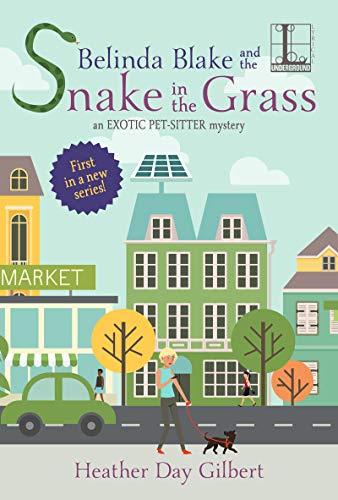
Howdy, howdy! Can you believe it’s already the last Wednesday of the month? You know what that means! It’s time for another book review. Since my mind has been drifting to my own cozy mystery, I decided to see if any new series in that genre were releasing this month. Yup! I went with the Exotic Pet-Sitter series because who can resist animals and a good murder or two? Not me. It’s by Heather Day Gilbert and the first book is called Belinda Blake and the Snake in the Grass (kind of a mouthful, I know). Since it was only released yesterday (June 25th), you would be correct in assuming that I got an Advance Reader Copy (ARC) through NetGalley. So, I must thank them and Kensington Books for allowing me access to this ARC in exchange for an honest and unbiased review, which I’ll be getting to presently.
A cute cover that has nothing to do with the story.
Belinda Blake and the Snake in the Grass follows (you guessed it!) Belinda Blake as she embarks on a new phase of her life. Moving from a studio apartment in Manhattan to a carriage house on some rich family’s property in Greenwich, Connecticut, Belinda works hard to keep her exotic pet-sitting business going strong. She’s currently taking care of a ball python for a client in Manhattan who insists she carts the animal back and forth from his place to hers (because snakes need vacations too) as well as taking it for walks and even bathing it. As if that plus an embarrassing run in with the homeowners’ handsome son, Stone Carrington the fifth, isn’t bad enough, she finds a dead woman in her garden. From there, things just get stranger.
The plot of this one is pretty standard. A young woman (26) finds a dead body and gets dragged into investigating it with the hot new guy in her life, who she falls in love with, of course. But could he possibly be the murderer?! Dun dun dun… It’s a cozy, so what do you think? He’s still shady, though. And I admit that I picked out the murderer as soon as they showed up, but it took me a little while to piece together the why part, so it’s still a fun journey.
My main problem with this story is the pacing and the odd scenes that feel tossed in for no particular reason. It’s super jumpy. Things would be going along nicely, then something completely random would pop up. Like the kiss. It doesn’t feel like it belongs there to me and it’s out of character for Belinda, so it seems really forced. Then, she goes home (upstate New York) for Thanksgiving and randomly gets sent to a neighbor’s house to pick up honey. I’m guessing he’s supposed to be the rival love interest, but his part in this particular book seems unnecessary and rushed. His introduction could’ve waited for a book or two until he’s needed. There’s also this thing with escaped cows that makes no real sense and does nothing for the actual plot of the story. There are some other instances, but these stand out the most.
Me wondering how things fit together in this book.
As far as the writing goes, it’s a little stilted in spots. The book is in first person, so we’re in Belinda’s head when we’re not dealing with dialogue. I spent a lot of time telling myself that people don’t talk that way. It’s distracting, but I was still able to enjoy the story.
Ultimately, I enjoyed Belinda Blake and the Snake in the Grass enough that I’ll check out the next book to see if it’s better. Also, I kind of want to see just how much randomness makes it into the next one.
Overall, I gave it 3 out of five stars. While many, my complaints are actually pretty minor. If you like cute cozies and animals, go ahead and check this one out. If you have too many books on your TBR lists, you’re not missing much if you skip this one.
Howdy, howdy! First and foremost, I want to thank Lew Andrada one last time for his awesome post last week. If you haven’t read it, you should go do that after you read and comment on this one! As for this week, I’ve been thinking a lot about stuff I read as a teenager or in my early 20s. And there are a lot of books that I would love to read again for various reasons, but I’m afraid it’ll ruin the love I hold for them. Like, what if they’re actually really bad and I’m just in love with the notion of them? I’ve gotten a lot of encouragement from friends to go ahead and make 2020 (and probably 2021 because I’m a slow reader and would still have to read new books to review) the year(s) of book nostalgia and re-read all the things, but the fear is real. So, I thought I’d list the 35 books I want to read again and ask everyone for opinions on whether it’s a bad idea in general or which ones would best be left in the past, etc.
Probably stupid.
1. The Harry Potter series (7 books). I’ve only read the series all the way through once. Yeah, I’m a bad fan. Whatever. But I’ve been getting the itch to go through it all again. I’m not too worried about ruining this one, though. It’s the series I remember the best.
2. The Chronicles of Narnia (7 books). I blew through this series in my mid-teens and can only vaguely remember it, which is why I want to read it again. Granted, the memories are fond ones, but I still worry that maybe it wasn’t that good. It has a decent sized fan base, but I often dislike books everyone else seems to love. It’s worrisome.
3. The Anne of Green Gables series (9 books). Normally, I hate slice-of-life (not sure if that’s an actual genre, but it’s what I’ve always called things like this series) books. It makes me curious as to why I enjoyed this series as a teenager. It’s one of the few that I’m most afraid of ruining for myself.
Will it, though?
4. His Dark Materials (3 books). This was a series I read in my early 20s. I remember a bit of it, but not enough to read the Book of Dust series or any of the stories connected to His Dark Materials. This is the usual predicament that forces me to re-read things.
5. The Hobbit and The Lord of the Rings trilogy (4 books). I’ve actually read these twice already, but I wouldn’t mind going back to them. Just because. There are some books that call to you. It happens.
6. The Girl Who Loved Tom Gordon and The Talisman (2 books). It’s not often that I feel the desire to re-read Stephen King stuff, but these are two I’m feeling drawn back to. Will they stand up against the test of time? I don’t know. Am I willing to risk it? Don’t know that either.
7. Neverwhere (1 book). So, I have a love/hate relationship with Gaiman. I absolutely love his work, but there’s always something I hate about his stories. Neverwhere started my love of his work. The problem is that I can’t remember hating anything about it. That worries me, because what if it’s truly horrible and I’ve blocked it out?
So many worries…
8. Ransom (1 book). This one I actually read back in 4th or 5th grade. I’ve never read anything else by Lois Duncan, but this one stuck with me. It’s the first book I read that had someone with a disability who played a major role. Granted, he wasn’t disabled like I am, but it was cool. I’m afraid that connection was the only actual good thing about the book.
9. The Wild Iris (1 book). I fully admit that I re-read poetry more than anything else. This is a collection I’ve been meaning to read again for years.
So, what are your thoughts on reading things more than once? Is it a worthwhile endeavor or would you stick with new books? Anything on this list that isn’t worth a second look? What’s on your list? Feel free to share your comments or thoughts here or on my social media pages!
Hello, hello! Welcome to 2019’s first guest post. The illness of doom kept me from finding a victim (aka an awesome person who was willing to help me out) back in March, so I decided to wait and open with the incredible Lew Andrada who offered to sacrifice himself this month. A fellow alum of Stonecoast, we met briefly during my graduation semester/his first semester and have maintained a writerly and foodie friendship on the book of faces. The following post is a wonderful tale of how he fell down the academic writing well. Read on!
Lew Andrada!
Academic Writing: A Style I Once Despised
When I began my MFA program for creative writing at Stonecoast back in the winter of 2015, I could barely contain my excitement. I had a rare opportunity to hone the craft that I had first begun practicing as a young kid watching Saturday morning cartoons. While my days of writing Ninja Turtles fan fiction were essentially over, Stonecoast offered a focus on popular fiction that would allow me to explore and expand my understanding of my favorite genres, specifically fantasy and horror. I remember looking forward to everything: workshops, lectures, hanging out with my fellow classmates and writers… But there was one thing that I had dreaded. Stonecoast requires a third semester project, one with a more academic bent to it than the creative projects necessary for the other semesters. Academic writing wasn’t one of my strong suits in undergrad. There’s very little wiggle room in terms of creativity, and the tone can often come off as “dry.” Granted, I was a biology major with an English minor, so the majority of papers I had to write were scientific in style and nature. When the time came for my third semester project, I had a lot of anxiety, especially since I was working with the esteemed Elizabeth Hand as my mentor.
They knew Lew could do it!
I chose a topic that was related to my second semester project, which focused on writing short stories with a humorous bent. My essay explored the evolution of humor techniques from Victorian Era comic fantasy to contemporary comic fantasy written from the 1970’s and onward. I won’t lie; it was a stressful experience. I had a lot of reading and research to do in a short amount of time. The finished product, however, ended up being something I was quite proud of. After graduating from Stonecoast, I didn’t think I’d ever have to worry about academic writing again. I would focus on my fiction and go on to make millions of dollars a la Stephen King or J.K. Rowling. But wait! Just like any good story, there’s a plot twist.
I had previously heard about an academic conference focused on genre fiction from my second semester mentor, Theodora Goss. Some of my classmates (shout-out to the hammocks!) had presented at the International Conference of the Fantastic in the Arts (ICFA) and talked about the fascinating blend of fiction and scholarship that thrived at this event. I was interested but hesitant because of my anxiety with academic writing. There’s a lot of pressure when writing about “facts” because you have to get everything “right.” On top of that, I didn’t feel comfortable with the possibility of presenting a paper in front of a room full of academic hard-hitters. After some reassurance from my writer friends and some helpful examples from Dora, I decided to give academic writing another shot. I wrote an abstract on the effects of Spanish and U.S. colonialism on Philippine speculative fiction, received an acceptance letter, and tackled the paper with gusto. I presented the finished product at ICFA last year, and much to my surprise, it was received with enthusiasm. Fast forward to present day: 1) I attended ICFA again this year, presenting a paper on the writings of Nick Joaquín and how his style of Philippine magical realism explored the complicated relationships and dynamics of Filipino families; and 2) I’m currently working on two academic papers that have a strong shot at being published.
So how did I get here? As someone who has never really enjoyed academic writing, how did I end up pursuing this style as a part of my writing repertoire? I can think of at least two major reasons:
My paper topics reflect my reading interests. Academic writing requires a TON of reading. Fortunately, that’s something I enjoy even when it’s not required. In the case of the academic papers and essays I’ve written, I’ve always chosen a topic that results in me reading stuff I find interesting, whether it be comic fantasy or Philippine speculative fiction. Having an sense of curiosity for my chosen topic motivates me to get through the hardest part of academic writing, which is the stacks and stacks of reading material. Once that’s all done, the writing is so much easier to tackle. Love what you read, and the rest will take care of itself.
I have a personal connection to my chosen topics. For the past two conference papers I’ve written, the focus has been on Philippine literature. That’s become something near and dear to me. Being Filipino American and the son of immigrants, I’m always looking for ways to reconnect with my culture, my heritage, and my roots. By examining the history of Philippine speculative fiction, I feel like I’m learning more about myself, and at the same time, my resulting work provides awareness for a culture that’s often forgotten in the United States. The Philippines was a U.S. colony for almost 50 years. Because Philippine history is also U.S. history, I want to help promote Philippine literature. Much of it is written in English, which is the second official language of the island nation. Yet many Americans couldn’t name a single Filipino writer. While my research interests focus on speculative fiction, in a way, my papers are also providing an opportunity for people to discover new writers and hopefully expand their reading interests beyond what’s published in the United States.
So here’s the takeaway message. As a writer, you shouldn’t limit yourself to only writing in the styles you feel comfortable with. Don’t be afraid to take chances on projects that give you anxiety. Don’t be afraid to tackle imposing challenges. There’s a possibility that you may discover something that you can latch on to and make it all your own.
Lew Andrada received his BS in biology and minor in English from UCLA in 2006. He then received his MFA in creative writing – with an emphasis on popular fiction – from Stonecoast at the University of Southern Maine in 2017. He currently works as a research assistant at the UCLA Department of Radiology, a position he has held for more than 12 years. Aside from his regular day job, Lew also teaches World Literature and English Composition online for the University of the People. He has presented two academic papers at the International Conference on the Fantastic in the Arts: “The Lingering Effects of Colonialism on Modern Philippine Speculative Fiction” (2017) and “Nick Joaquín and the Tropical Gothic: How Magical Realism Explores Philippine Family Politics and Legacies” (2018). Lew was a fiction editor for the literary magazine, Stonecoast Review, for Issue 8 and also served as a first reader for over two years. His short fiction has been published in The UCLA Beat, The Literary Hatchet, and The Journal of Unlikely Entomology, among others. His home on the web can be found at lewandrada.com, where he blogs about writing, travelling, video games, and other random topics of interest.
Howdy, howdy! Welcome to June. How’s everyone doing? Is the year going the way you were hoping so far? Things have been weird for me with random bursts of productivity and bouts of “why bother?” generously sprinkled throughout. I’m having more trouble than usual coming up with blog post topics, if you can’t tell. It got me thinking about the writer’s life and wondering where I’m going wrong. I Googled writer problems and found a few lists of “deadly sins,” but none of them quite worked for me. Don’t get me wrong, they were cool in their own right, but many were directed toward the technical aspects of writing which aren’t where I’m having trouble. So, I came up with my own list of seven deadly sins.
1. Vanity/Pride. The mother of all sins is dangerous for a writer, especially when we start thinking our stuff doesn’t need to be revised or changed. When we’re not open to critique from our peers. It’s perfect as is. But art is never perfect. The story may be great, but there’s always room for improvement. A great story could become fantastic if you listen to others’ thoughts. I never used to revise things, because they were “good enough.” I learned a long time ago that that thinking was flawed. Granted, I still hate revising pieces, but it’s usually because I’m not sure how to implement the changes I want to include.
2. Avarice/Greed. Writing isn’t really a gig to get into if you’re just looking to make some quick money. I mean, it would be nice to earn a comfortable living off of it and it’s totally fine to daydream about, but let’s be honest… we aren’t all Stephen King or J.K. Rowling. And that’s okay. It doesn’t make us any lesser as writers. They work hard just like we do, but they eventually got lucky. If we persevere, we might get lucky too. But don’t expect an easy payday in this line of work.
Don’t be like Greed from FMA.
3. Wrath. If constant rejection and critique upsets you, writing isn’t the job for you. This is one of the few things I haven’t really been bothered by. If someone dislikes my work or thinks I need to change things, that’s their opinions. I take what’s useful to me and put the rest aside. As far as rejections go, in total I’m nearing 300. It’s just part of writing. It stings sometimes, which is fine. We’re human. We’re allowed to get upset. But if it stops you from submitting, then you won’t last long as a writer.
4. Gluttony. If you do anything too much, you’re going to burn yourself out. This includes writing and reading. I do this a lot on both fronts, but especially with writing. I’ll get in a good rhythm and forget to take a break until I hit a wall and the words just won’t come, then I fall into a bout of laziness (see Sloth). I know it’s super hard to find a balance, but remember to take a break now and then.
5. Sloth. You remember that laziness I was just talking about? This is that. For me, sloth is putting off writing until I know what I want to say, which never happens. I have a general idea of the story, but I don’t really know where it’s going until I start writing. I know this. Yet I still get lazy and use plotting as an excuse not to write. But if you never actually write anything, you’re not really a writer.
Because sloths are cute.
6. Envy. I am guilty of this. Of course I support my writer friends unconditionally, but I admit to feeling the occasional twinge of jealousy. Humans do this and as much as I hate to admit it, I’m human. I don’t let it get in the way of being excited for them and cheering them on, though. Writing is lonely enough. If you start getting upset and jealous at others’ successes, it’s just going to get lonelier.
7. Lust. I had a hard time making this one work for writing, but then I thought about the fact that we all have authors we lust after in one way or another. A lot of times it even appears in our work because we imitate them. Imitation is a good teaching tool, but if writers don’t make the style their own, it comes off as derivative. So, lust after whoever you want, but don’t just copy them. Make it your own.
And that’s how I interpret the seven deadly sins for writing. What do you agree with? What would you change? Feel free to share your thoughts and comments here or on my social media pages!



 Shawna's Blog of Doom