Screen Vs. Paper

Hello, hello!  How is everyone’s March going?  Are we all ready for spring?  Personally, I’m definitely ready to sit outside and write or read.  The only problem with writing outside is that I use my computer (and its battery sucks), so I only get about two hours if I’m lucky before it has to be plugged back in.  Which brings me to today’s topic: screen vs. paper.  It’s a subjective topic.  Some people work better when typing and others feel more productive with a pen in their hand.  I’m kind of stuck in the middle on this one.

notebook-computer-writing-blogging
They both have benefits and drawbacks.

I tend to be a screen person.  Why?  Simply because it’s easier for me.  Whether I’m using my backscratcher to hit the keys or the on-screen keyboard, I can type much faster than I can write.  It’s not that I feel more productive (though technically I am) or creative when I’m on the computer, it’s just a matter of time management and the independence it gives me to work on whatever I want without having to worry about asking someone (namely Dad) for more paper or a different binder or whatever when I want to change projects.  For me, the computer makes life easier, so it’s what I use.

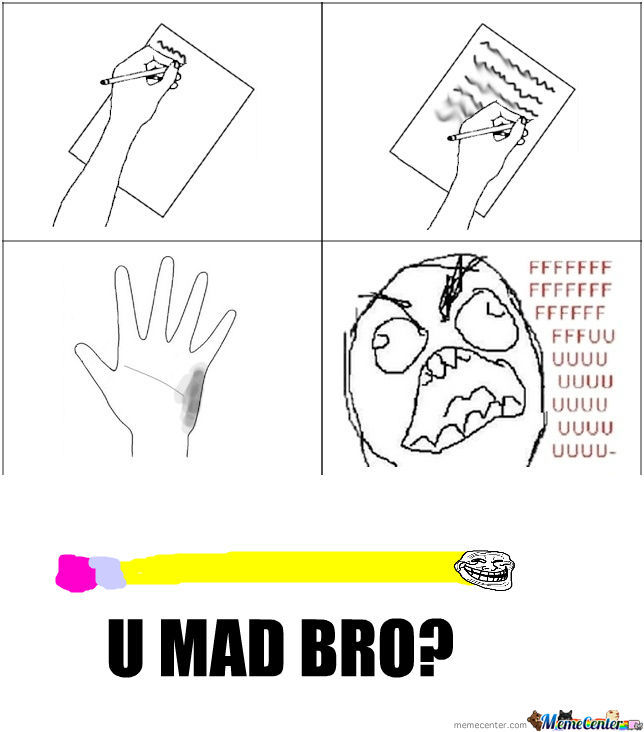
What most people don’t know is that I actually enjoy using a pen and paper.  I’ve always loved notebooks and journals and the like.  I used to have tons of them, but they mostly stayed empty.  It takes me twice as long as the slowest writer you know to even sign my name.  The paper has to be placed a certain way.  Sometimes, I have to write upside down.  I can’t move my arms much, so even something as simple as writing by hand becomes a big production.  But still, I like the feel of a pen in hand and my hand coming away covered in ink or graphite from rubbing across the page (left-handed people will understand).  Plus, I like being able to doodle in the margins when I’m stuck on something.
7
The struggle is real.

So, like I said, I’m stuck in the middle.  I love the idea of writing by hand, but it’s not a feasible every day thing for me, so I usually go with typing.  I can definitely see where some people might have trouble focusing on a computer (that Internet button is so damn alluring).  I can also understand why some people find paper to be impractical (there’s just no easy way to erase a sentence and add a paragraph in its place without making a seeming mess of the paper).  I guess I’m lucky that I can enjoy working both ways, even if I mainly stick to the screen.
squirrel of judgment
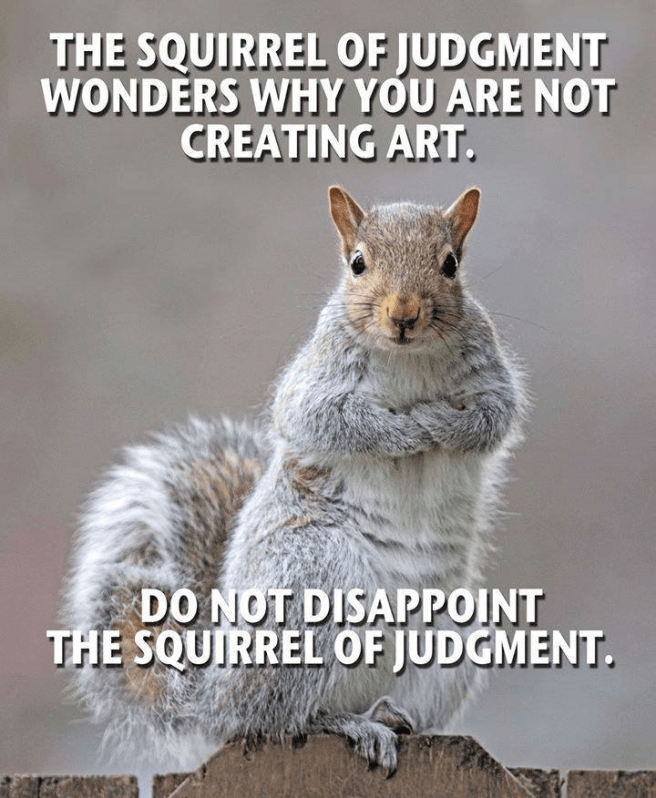
The lure of the Interwebz has its downsides: judgmental squirrels.

I guess it’s all about finding what works for you.  Are you a screen or paper person?  This question isn’t limited to writers.  Even artists have the option of working on the computer or in more traditional mediums.  So, what do you prefer?  Or maybe you like using both in your process.  As always, feel free to share your thoughts here or on my social media sites!

Until next time!

Being Organized: Overrated Or No?


Howdy, howdy!  I was recently going through my manuscripts and free writes when I realized that I’m totally unorganized.  It’s all jammed into the same folder on my laptop, except for my main project (that gets its own folder with subfolders and the whole nine yards).  This is really unusual for me.  I don’t like having to scroll through a bunch of stuff to find what I want, let alone having to open multiple files to find the correct version.  That’s just not me.  Yet here I am, sifting through a mess.  It’s weird and uncomfortable, but for some reason, I kind of like it.

1516651974-funny-quote-about-organized-people
I really am.

Walking into my room, you might not think I’m as organized as I actually like to be.  My desk is a complete mess.  My CDs are no longer alphabetized by band, then chronologically by release date.  There’s no real rhyme or reason to my closets/drawers.  Why?  Because I can’t organize everything myself.  I know my Dad would sit down and organize everything if I asked him to, but I’m not going to waste his time with my quirks.  I know basically where everything is, so I’m not too worried about it.  My computer, however, has folders with subfolders arranged by whatever works.  I’ve gotten a little lax when it comes to organizing my pictures, I admit, but everything else has its own little place.  Usually.  My manuscripts turned out to be a mess I didn’t realize was piling up.

I was looking for a specific story, but I couldn’t remember what I called it and whether it was in its own document or bundled together in one of my free write documents.  I ended up going through three different folders (because apparently I wrote it as an undergrad and never moved it into the current manuscripts folder).  Normally, this would frustrate me to no end.  But I ended up finding a bunch of incomplete ideas that I had totally forgotten about.  Apparently, I have a lot more ideas for novels and short stories than I realized.  A lot of it was useless and stupid, but there were some gems hidden in the muck.

4533bccd-ac5f-4a0b-9398-a3667d4362f7
Weirdly true.

I can admit that it was fun taking the time to look through files I wouldn’t have otherwise given a second glance.  Being super organized means you’re occasionally going to overlook the small stuff.  Most of the time, I’m okay with that.  But I think I might just leave my manuscript folder a little messy.  That way, I’ll be able to take the time to look at those mystery documents once in a while.  But I’m definitely going to take a day or two to get my pictures back in order.  I’m not ready to let loose that much.

5PBD6Pj.gif
A messy folder is the equivalent of letting my hair down, but keeping it tightly braided.

So, I guess I’m trying to say that I can see the benefits of being a little disorganized.  I probably won’t ever be the type of person who’s comfortable not knowing where everything is, but I can deal with it.  What about you?  Are you super organized or do you like disorder?

The Between Space

Hello, hello!  I hope those of you who had a long weekend for President’s day got to do something fun.  My weekend was quiet.  Anyway, you know that space between being awake and being asleep, where you’re never sure if you’re dreaming or if something is really happening?  That’s what I want to talk about today.  It’s the place many of my story ideas come from.  It’s not an entirely pleasant place, but it’s useful.  Sometimes.  Often, it just likes to scare me silly.  I’m really curious about other people’s relationship with this space as well, so think about sharing your own experience with me.

teddy-bears-protecting-children
Either I’m not innocent or my stuffed animals are slacking.

First, I should probably mention that I’m not a visual thinker like a lot of people seem to be, I almost exclusively think in words.  People will ask me to picture something in my mind and I can’t.  The only time I can think in pictures is when I’m super tired and drifting in and out of sleep.  When that happens, I usually start out thinking in words and they gradually morph into a kind of dream/mental movie.  I guess that’s part of my attraction to this place.  It lets me work through things differently than I normally do.

I suppose the reason that I credit this space with a lot of my story ideas is because it’s a lot easier to remember details from these half awake dreams than it is when I wake up with an idea from a normal dream.  Those ideas tend to be vague scenarios that may or may not be interesting.  They’re good story seeds, but the ideas that bloom in that weird little realm between worlds are the ones most readily written.

7220b0ada6c7ce905ca4d8951b87118e
And that place certainly is dark enough.

Granted, my time spent in that realm more often than not leads to nothing other than a few scares (those stupid jolt awake moments) followed by my mind running through all the horrific scenarios of what could have possibly woken me.  It’s usually noises.  There’re the bumps and thumps of zombies trying to get inside.  Werewolves are not an uncommon expectation.  The train horn usually conjures thoughts of serial killers and creepy clowns jumping off the train and murdering their way through town.  Most people (at least according to TV and movies) wake up assuming the wind or something equally as mundane unless they hear something after the initial jolt.  Not me.  My mind automatically goes to death and destruction and knows the only reason I’m not hearing anything else is because the culprit is luring me into a false sense of security.  I might’ve watched and read too much weird stuff as a kid.

3d2667acd3c33445c8995048628977a2
These types of thoughts usually follow the paranoia.

So, whether I’m just hanging out in the middle of random thoughts waiting to be jolted awake or having a story bloom in my head, I have an odd love for that space between waking and sleeping.  I like seeing my thoughts unfold rather than just telling myself things.  What about you?  Do you enjoy hanging out in that little realm?  Does it let you see everything differently?  As always, feel free to comment here or on my social media pages!

Plotter Vs. Pantser

Hello, hello!  It’s been awhile since I’ve really written something writing related, so I thought I should probably get back to that.  After a long day of errands and asking people what I should blog about, a friend brought up the question of whether I’m a plotter or a pantser.  Basically, do I outline my stories or do I let them grow organically.  I’m sure I’ve at least glanced over this at some point in the past two years (I’ve kept a blog going for two years???  Who’d’ve thunk it?), but I decided to take a minute to dig deeper into this seeming dichotomy.

issue7
From So You WriteI still don’t know all the abbreviations, so don’t feel bad.

First, let’s take a look at plotters.  These are the people who get a story idea, then spend hours or days or weeks or longer plotting out all of the details and creating outlines and character bios and the like (and even charts or graphs for the hardcore plotters).  Some of them plan every little thing ahead of time.  Others write out the broad strokes (major plot points and characters and all of that) but leave connecting the dots until the actual writing process.  This works really well for some people, but it’s not the only way to write.

leqoiq575v_1437536694125
Just one example of plotting, courtesy of J.K. Rowling.

On the other hand, you have pantsers.  These are the people who get a story idea and just go with it.  Characters and adventures come and go organically as the story unfolds on the page.  Many of them have no notes beyond the story itself.  Some take notes as they go, so they don’t have to keep scrolling through their story to remember what someone was wearing or whatever.  Others plot things out in their head as they go, but allow the story to ultimately dictate what happens.  They aren’t afraid of getting sidetracked by a character who refuses to do what was planned.  In other words, they fly by the seat of their pants.

As different as these two things are, I think they’re more two ends of a spectrum than separate identities.  I certainly know people who are strict plotters and others who refuse to even attempt the restrictions of planning things out, but I prefer taking the middle ground.  I fully admit that I have more pantser tendencies than not.  I’ve always had trouble creating (and adhering to) outlines.  All of my stories start organically and I prefer to let them unfold on their own, but I do get stuck sometimes when I do it that way.  That’s when I switch to plotter mode.  I write a rant (I literally whine and complain and generally grump during this whole process) to myself figuring out where I want the story to go, then once I get back on track, I switch back to pantser mode.  There’s no shame in swinging both ways.

spockkirk_ed6bcd_4777877
How most pantsers feel when dealing with unruly characters.

There’s no one right way to be a writer.  Anyone who tells you otherwise is a Liar McLiarson, so don’t listen to them.  Don’t be afraid to try plotting if you’re a pantser.  It can really help things flow better when you’re stuck.  Also, try flying by the seat of your pants occasionally if you’re a plotter.  It can be freeing and new, exciting things could happen.

What are your thoughts on plotters vs. pantsers?  Which one are you?  Or do you dabble in both?  As always, leave a comment here or on my social media pages!

Until next week!

Accountability: Like Due Dates But Different

Howdy, howdy!  I was really having a hard time deciding what to write about when a friend sent me a text thanking me for being the voice in her head asking if she was at least thinking about writing.  It gave her the nudge she needed to stop at a place after work and take a little while to have a cup of tea and write some words.  She hadn’t written in a while, but she wanted to, so I told her I’d pester her every day or so until she started writing.  The second day of pestering and she’s already making time for it.  That’s what happens when you’re held accountable for things like this, you make time for them.

castiel
I know, Cas.  I know.  I’ll go do that.

 I don’t know about you, but I always work better with deadlines in place.  At school, I could knock a ten page paper out in one night if I had to, as long as the research was done ahead of time.  Deadlines meant grades.  In the real world, missing deadlines affects the pay from the day job.  In other words, deadlines carry the threat of consequences.  But what’s going to happen if you don’t finish a novel?  Unless you have a contract with a due date, nothing will happen.  So, how do writers overcome this lack of a threat and finish things?  We hold each other accountable.

In the beginning, I didn’t really understand how holding each other accountable would work.  After all, if I don’t push myself to finish something, why would someone judging me for it be motivational?  Turns out that guilt is a powerful tool.  If I set reasonable goals with people and don’t reach them, I feel guilty.  I don’t care if the end of the world pops up, if people know I planned on doing things and failed, it sucks.  It also helps that I’m mildly competitive, so failure and losing are not an option.  I won’t be the only one to not meet my goals.

httvk
Mixed signals achieved.

 According to people I’ve done this whole accountability thing with, it also works by legitimizing their craft, especially when they have jobs.  They have trouble taking time out of their schedules to write because they feel like it shouldn’t be a priority even when they secretly (or not so secretly) want it to be.  Having someone who will pester them and encourage them gives them an “excuse” to make time for writing.

calvinwriting
You can’t keep waiting when there’s no last minute.

 So, even when deadlines aren’t an option, we can still motivate each other by holding each other accountable.  We might not receive any real negative consequences if we don’t meet our goals, but we’ll have to live with the shame of disappointing our friends.  Who has time for that?

Do you have any friends who pester you about your creative outlet?  Does accountability work for you?  How?  If not, what do you do to stay productive and motivated?  Leave a comment here or on my social media pages to share your thoughts!

Until next week!

A Writer’s Tale

Hello, hello!  I was at a loss over what to write for today.  My usual plea for topic ideas proved unfruitful this time.  Then, I realized that I have never shared my journey to writerhood on here.  At least I don’t think I have.  Feel free to stop reading if you’ve heard this story before.

I’ve always written.  Stories, poems, the occasional attempt at a comic strip (but my drawing skills failed me there).  I never really wanted to be a professional, though, so I’m a little different from my friends and fellow writers who have wanted to do this forever.  My crazy job goal was always a fashion designer, but when I figured out that wasn’t going to happen, I set my sights on more obtainable professions.

southern-methodist-university-beautiful-college-universities
Dallas Hall at SMU.  This campus is where my plan tumbled down.

 I went through most of my time at college (both community and university) waffling between psychology and English.  With psychology, I could help kids like myself.  After all, all the psychologists I saw walked into the room and presumed to know how I felt.  It never seemed right to me.  At least I would appear a little more relatable than they did to me.  I also kept returning to English because it was easy and I enjoyed it.  In fact, by the time I transferred to SMU (I went in as a Junior), the only degrees I had time to finish were psychology and English.

Since I had a semblance of a plan with psychology, I initially decided to go with that major.  It was going well.  I passed all my classes with fairly high grades (never less than a B).  I really got into abnormal psychology, especially the class that focused on disorders in children.  I aced my research class paper.  But I still kept taking English classes as well.

2c5377c130a4205d2afe15b420112a517aafe30bee6ac6c260d13f0888601e6b
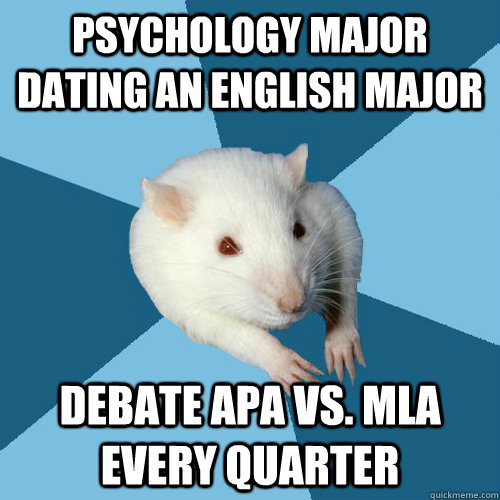
Try having the debate with yourself.  I still secretly prefer APA.

 Then, that fateful day came.  Dad was walking me to class after a stop at the campus coffee shop and we were talking about majors and what I was planning to do, when he asked the question that shattered my little plan.  “How’re you supposed to be a psychologist when you don’t like people?”  He was right.  I’m not a people person.  I don’t like to pry.  I’ll offer advice when asked, but beyond that you’re on your own.  What kind of psychologist would I be?  I could go into research, but I don’t even like that.  Thus, I became an English major.

35
Don’t fall for the hype!

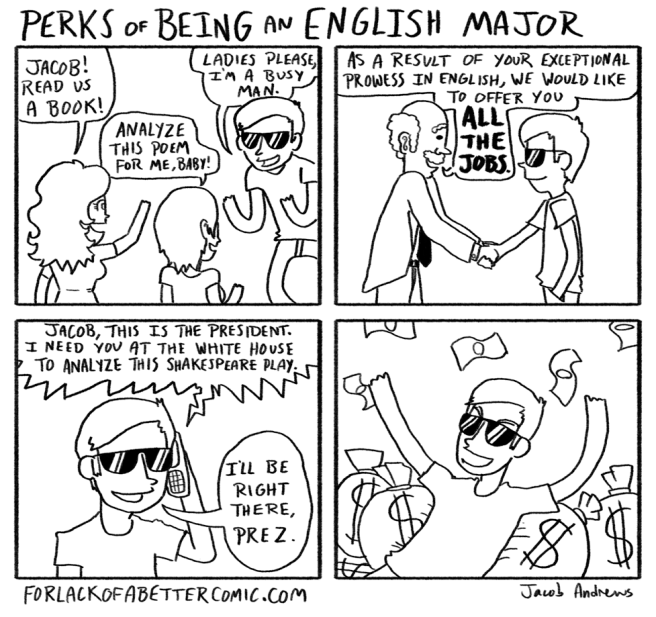
 What was I supposed to do with an English major?  I had zero desire to teach.  So, I took some creative writing courses, found out that I still enjoyed writing, and dipped my toe into the big bad world of writerhood.  And that’s how I found myself on a path that would take me to Stonecoast and onto a place where I could live with the voices inside my head without having to worry about people.

How did you decide to pursue the path you’re on?  Did you always know you wanted to do it or did it spring itself on you?  Tell me your story in the comments or on my social media pages!

Dreamscapes And Stories

Valentina RemenarHowdy, howdy!  Did everyone have a nice Thanksgiving?  I must admit that I had a lovely day with delicious food and great company.  As for today’s post, I wanted to talk a little about dreams and how they influence my writing.  Why?  Because a couple of friends wanted to know if I remember my dreams and, if so, do they affect my writing in any way.  The short answer is: occasionally.  The dreams I do remember tend to be boring every day type things (usually just conversations with a random person) or terrifying nightmares that I bury deep down inside my mind.  There’s rarely anything between the two.  But, it’s the in between that usually become stories themselves.

DREAMS
Dreams by Valentina Remenar.

Most of the time, my dreams fade away as quickly as they come.  If I do remember anything, it’s usually unintelligible garbage that I ignore or, if I’m having issues with a particular story and I’m getting desperate, I sift through in the hopes of finding some magical answer.  I’ve never had anything happen that’s as fabulous as the image above, but my dreams can still be pretty cool.  In other words, while dreams are neat and sometimes helpful, they aren’t an integral part of my writing system.

If I’m lucky, I’ll find an answer to a plot problem if I really focus on a certain part of a dream.  The most recent example I have is actually from last night.  I was having one of my stupid conversation dreams (I don’t even remember who I was talking to), and the only topic that stuck out to me was a random mention of Medusa.  I’ve been trying to figure out how to insert some more hints at demons and monsters early on in G&G, but I was stuck at a part in chapter three that I had no clue how to tweak.  A version of Medusa’s powers will actually really help me out there.

med09l
Snakes are fun.

 In extremely rare instances, I’ll come away from a dream with a story idea.  I can actually only think of two off the top of my head.  I even wrote a little synopsis of one to help me remember it:

Dream Idea – Nick has no luck with animals. The one pet he had as a kid died, and his mother refused to give details. He constantly feels like he’s being watched, and has nightmares of nothing but blood. Little does he know that two factions of shifters are after him to be their savior. One wants death and destruction, the other wants peace. Which one will win his allegiance?

This was written after a bigger story started formulating in my head.  The dream itself was actually just a kid playing outside with a puppy that ended really bad with blood and yelping and sadness.  And there were two pairs of glowing eyes in the bushes on either side of the yard.  It was weird and creepy and memorable.  I got distracted by other stories, though, so I haven’t worked on this one.

5c4f45515821e95d171e43f2f81a6869
I hope not.  My nightmares tend to be recurring.

 So, I guess my dreams influence my writing sometimes, but not as much as other things.  Daydreams, on the other hand, play a huge role in my writing.  But that’s a topic for another time.  What about you?  Do your dreams influence your creative processes?  To what extent?  Leave your thoughts and comments here or on my social media pages.

The Most Common Writing Advice And Why I Disagree

Howdy, howdy!  I hope everyone had a fun and safe Halloween, and got tons of candy (whether you went trick or treating yourself or stole it from your kids/nieces/nephews/siblings/etc.).  Today, I want to ramble a little bit about some common writing advice that I really disagree with.  If you’re a writer, chances are that you’ve heard this statement at least once (and probably way more than that): write what you know.  On the surface, it sounds like common sense.  If you don’t know about something, how can you write about it?  But so many people take it too literally.

ch940305
No one wants to read about that, Calvin.  Unless the guy is transported into each show, then maybe.

 On the one hand, some people argue that the saying refers to emotions.  We’ve all experienced love and hate and happiness and anger, so our characters should too.  I agree with that reading of it to a point.  Characters need to express multiple emotions in order to be well-rounded.  My issue with this explanation is that we all experience and express our emotions differently, so our characters should too.  For instance, when I rage, I stew in my own thoughts and plot revenge.  I don’t really know what people who scream and cuss and break things are thinking or feeling.  Does that mean I should only write characters who stew?  No.  It just means that I have to work a little harder to understand and flesh out my characters who are screamers.

On the other hand, there are the people who think writing what they know means writing about things they’ve done or stuff that’s happened to them.  I actually started writing Garnets and Guardians because people kept telling me to write what I know.  I know about spending your childhood in and out of the hospital.  But honestly, that’s boring, so I threw in demons and references to different mythologies and a protagonist with a disease that’s fairly different from my own.  These are things that I knew little to nothing about.  Hell, my protagonist can walk.  I don’t even remember what walking feels like.  Does any of this mean I shouldn’t write about these things?  No.  It simply means I have to study up on them.  Writers enjoy research (supposedly).  It’s half the fun of writing.

11416205_10153290730191291_1790979666738184094_n
It’s kind of like that.

 I guess if I were to rewrite the quote, I’d probably go with something like “write what excites you.”  Not in a porny way, though.  What I mean is, if you’re super interested in writing about a guy who has to fight ice giants while climbing Mt. Everest, but you have no idea what mountain climbing entails, go out and learn about it.  Sure, once you learn about it, you know it, and thus the original quote applies, but it’s still up to you to study these things in the first place.  If it drives you to research something, it’s worth writing, even if you have zero experience with it.  So, write what you want.  Learn things.  Don’t limit yourself just because you’re inexperienced with something.

tumblr_manvvhrldo1r70ryuo1_500
Because Odin. And election day is soon.

 What’re your thoughts on “write what you know?”  Is there any common writing advice that you disagree with?  As always, feel free to share your thoughts and opinions in the comments or on my social media pages!

Productive Procrastination: Just Go With It

Hello, hello!  It’s been a slow couple of weeks writing-wise.  I’ve been re-reading Garnets and Guardians in preparation for another round of edits (it really shouldn’t have taken me two weeks to get through it, but I was lazy and not so productively procrastinating).  At the same time, Dad was doing a deep clean of the house and, when it came down to the last room or so, he started doing everything except cleaning what he said he was going to (he did the laundry, ran errands, put knobs and pulls on some cabinets and drawers, etc.).  When I picked on him for procrastinating, he denied it because he was doing things that needed to be done.  That’s exactly what productive procrastination is: doing things that need to be done eventually instead of what you’re supposed to be doing.  Apparently we all do it, not just writers.  I felt much better about myself when I realized that.

everyone-poops
It’s kind of like when you realize everyone poops.  You’re not a freak anymore.  And yes, this is a real children’s book.

 I know writers who clean their house or run errands or answer emails when they’re supposed to be writing.  I tidy up my computer files when I’m desperate to avoid writing.  I also volunteer to read for people when I’m looking for a break.  There are all kinds of ways to avoid what you’re supposed to be doing when you have other stuff to focus on.  I know some people who keep busy by working on a short story or two instead of the novel they’re in the middle of writing.  I’m supposed to start edits on G&G today, but I might just write a ten minute play instead.  Sometimes, the brain insists you do something else.  That’s okay.

Productive procrastination plays two important roles in life.  First, it gives you a well-deserved break while keeping you from feeling guilty for not doing something that needs to be done.  Sitting around and binge watching Netflix instead of writing feels like a no-no, but fold the laundry while you’re doing it and suddenly it’s not so bad.  And second, it gives us the motivation to do all the little things no one really wants to do.  I didn’t really want to do my checkbook the other day, but I didn’t want to read G&G again even more, so guess which one got done first.  It forces us to prioritize things.

procrastinate-productively-work-hacks-02
Exactly.

 Eventually, you’ll run out of things that are less painful than whatever you’re supposed to be doing, or you’ll realize you have a deadline looming, and you’ll suck it up and do the thing.  If not, then whatever it was wasn’t that important to you in the first place.  As long as you’re getting something done, take it as a win.  Yeah, I feel guilty when I don’t get my writing or edits or whatever done, but as long as I did something important in its place, I’m happy.  Every task completed during procrastination is one less thing you have to worry about the next day.  Enjoy it.

phd010408s
Embrace the productivity.

Are you a productive procrastinator?  How do you decide when enough is enough and you should do the thing you’re supposed to do?  Is there a method to your procrastination or do you simply do whatever pops to mind first?  Feel free to share your words of advice with us.

See you next week!

Brace Yourself: NaNoWriMo Is Coming

Hello, hello!  It’s already nearing mid-October, which means November is right around the corner.  We all know what that means, right?  And no, I’m not talking about the election.  It means that NaNoWriMo is almost upon us.  For those of you who don’t know what that is, it’s National Novel Writing Month.  Every November, a bunch of writers (new and old alike) try to write a short novel (defined by the website as 50,000 words) or a good chunk of a larger novel in order to win prizes and bragging rights.

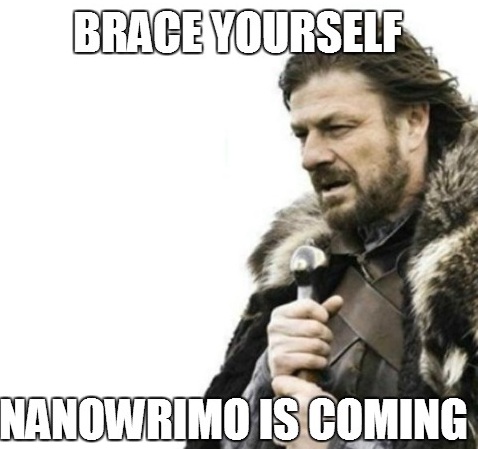
nanowrimo-is-coming
It’s like that.

 It’s a pretty interesting concept and their definition of “novel” is incredibly loose.  On the website, it says “We define a novel as ‘a lengthy work of fiction.’ Beyond that, we let you decide whether what you’re writing falls under the heading of ‘novel.’ In short: If you believe you’re writing a novel, we believe you’re writing a novel, too.”  It pretty much just requires you to write 50,000 words on one project in 30 days.  That’s roughly 1,667 words a day.  The goal is basically quantity over quality with the belief that it’s more important to get the words on the page, then you can revise and edit everything later to polish it up.  And the forum provides a nice community area full of helpful tips and plenty of others who are also procrastinating (why else would you be in the forums?).

I know many people who participate (many of whom often win), but I don’t.  I’ve tried in the past and failed miserably.  Up until recently, I couldn’t even fathom writing that many words in one day.  Even though I’ve done it before, I doubt I could do it more than two days in a row, let alone 30 days.  I don’t believe in writing every single day anyway.  It becomes a slog if I do that.  So, maybe I’ll try NaNoWriMo again in the future, but for now, I will remain a bystander cheering on those who do participate.

ohi0153-nano-2008nov03
Part of the bystander’s job? Remind them to write.

 Why must we brace ourselves even if we aren’t participating?  Because, our friends who are doing it will be posting about larger than average word counts (I know some people are sensitive about this and that’s okay), they’ll bounce back and forth between love and hate for the new novel more often than usual, and they will generally be in a writerly panic throughout the month of November.  As bystanders, it’s our job to provide love and support and understanding during this process.  It’s also our job to gently remind them to keep on schedule or catch up when they miss a day.  We never tell them to quit.  If they don’t reach 50,000, we don’t recognize that as a failure, we celebrate the words they did write.  This is how we help.  We also remind them to eat and sleep and shower if need be.  The bystander’s job is an important one.

aydredv_700b
This works for writers too, just make sure to include a computer or something for writing.

 Are you participating in NaNoWriMo or are you going to be a bystander?  Any words of advice for newbies on both sides?  If you need support and encouragement throughout the month (or want to talk about why your writer seems crazier than usual), don’t hesitate to get in touch.

Until next week!