Five Tips For Reading Aloud

Hello again!  Recently, I did a reading at Bonnie Jo Stufflebeam’s fifth annual Art & Words Show (for a look at last year’s show, see this post).  I fully admit that I was terrified, even though I was as prepared as I could possibly be.  It’s always unnerving to speak in front of a large group of people (or a small group, or anyone for that matter), at least to me.  So, I thought I would share a few of the tips I received before my graduation reading at Stonecoast, along with a couple of my own rituals.

me
Me reading.  Pardon the blurriness.

1.  Practice.  In order to read aloud well, you have to read the piece out loud.  This seems like common sense, but a lot of people don’t do it.  It’s how you learn what lines or phrases trip you up.  It’s how you get a feel for the rhythm of the piece.  For me, it’s how I figure out where to take breaths since I run out of air quicker than most.  I tend to practice once a day or so for at least two weeks (mostly because I get anxious if I don’t).  You can practice in front of loved ones, or you can be like me and do it in front of the computer.  My desktop usually has pictures of people, so I get the feeling of eyes on me, but if I screw up, no one actually witnesses it.  But yeah, practice.

2. Don’t expect a distraction free environment.  If you only practice in complete silence with no one around, distractions during the actual reading are more likely to be noticeable.  And let’s be honest, try as they might, the people who put these things together can’t guarantee absolute silence.  Be prepared for a cellphone going off or a door opening/closing or someone coughing or whatever.  I practice with my phone on and Dad bustling around in the other room and the dog wandering around and all that.  It makes ignoring the minor distractions during the actual reading much easier.

shiny
I can’t help with this.

3.  Wear something you feel confident and comfortable in.  If you look and feel good, it makes standing (or sitting) in front of people much easier.  It can’t be just one or the other.  If you feel smokin’ hot, but your legs are cramping up from those stilettos you aren’t used to wearing, your focus is going to be elsewhere.  On the flipside, if you show up in sweats and fuzzy slippers while everyone else is business casual, you’re going to feel out of place and your focus will still be affected.  So yeah, keep that in mind when picking an outfit.

4.  Have things scripted out.  This is more for the severe introverts like myself who don’t do well with ad libbing.  Write down everything you want to say and practice it along with your reading.  That being said, don’t freak out if you have to go off script.  You know exactly what you want to say, but you might have to reword it on the fly.  It’s terrifying, I know, but I find that if I have what I want to say in front of me, it’s much easier to pick out the main points and work them to fit the situation than it would be if I had to pick them out of thin air.

nearsighted-fb
This last one is for my nearsighted people.

5.  If you’re nearsighted and wear glasses, take them off.  I did this for my graduate reading and it made the reading much less intimidating.  The audience’s faces became a blur, so I couldn’t see any judgmental looks, but I could see my pages just fine.  For this recent reading, I kept my glasses on and kept my eyes on spots just above people or between two people every time I glanced up.  Avoid eye contact, but try not to make that avoidance obvious because apparently audiences like it when they think you’re looking at them.  It’s weird, but there are ways around it if it makes you nervous.

I admit that I’m not a seasoned reader, so any advice you can offer is welcome.  See you next week!

Another Writerly Achievement Unlocked

Hello, hello!  On Monday, September 26, while many of my friends were watching and commenting on what I’m sure was a magnificent presidential debate (I couldn’t even keep a straight face while typing that), I was finishing up the first draft of my current novel attempt!  Why is this an achievement?  Because I started it on February 29th.  I wrote a novel, 90,000 words, in less than a year.  I know that might not be awesome to other writers, but for me, it’s amazing!  So, I figured it would be okay to take one post to toot my own horn.  Sorry, not sorry.

keep-calm-i-just-leveled-up
At least it feels like I did.

 Now, the question becomes “What’s next?”  For this novel?  It gets to sit in its dark little corner of my computer for a while, all by itself.  I haven’t read through it to see if it’s any good, and honestly, I’d probably think it sucks if I did look at it right now.  So, I will be taking a break from it while I work on Garnets and Guardians for a bit.  I tend to have attachment issues to certain parts of my work if I don’t take some time away from it before edits, so I think this is the best course of action.  After all, no one likes dealing with a writer on an emotional rollercoaster.

11990590_10153498067101291_3835350904443490551_n
Time and space tempers this whole up and down thing.  Sometimes.

But first, there will be celebrating.  I still have no idea how I will celebrate, but I will.  Maybe I’ll buy myself a present.  Or maybe I’ll get a bag of chocolates.  Or maybe I’ll just take a couple of days off and binge watch Netflix.  I’m not very good at deciding how to reward myself.  Suggestions are welcome.

 Honestly, I’ll probably end up starting my initial read-through of G&G without taking more than a day’s break, because I really want to get back into it.  Has that ever happened to you?  A sudden itch to return to a certain world after an extended break?  It popped up a couple of months ago, so I sent G&G out for feedback in the hopes of having some suggestions when I finished the current novel attempt.  A couple of people got back to me, so I should be good to go.  I just don’t know where the urge came from.  I don’t usually have this problem.  It’s kind of neat, and worrisome.

10-funny-pictures-that-will-make-all-nigerian-writers-laugh-and-cry-all-at-once
This is usually what editing boils down to for me.

 Have you guys made any new achievements lately?  How did you/will you celebrate?  What did you move onto afterwards?  Or what do you plan to do?  Take a second to stop and congratulate yourself in the comments or on my social media!  I want to be able to celebrate with you.  No humble brags allowed.  Own your accomplishments!  Be loud and proud about them.  We’re here to support each other, in the good times as well as the bad.  I, for one, enjoy seeing my friends succeed.

Productivity Is Overrated

Hello, hello!  I know I’ve probably posted about feeling unproductive and all of that before, but I can’t find a specific post, so that’s what you’re getting today.  I asked for some blog topic suggestions for today’s post and my friends did not disappoint.  One of them asked “What do you do when you feel unproductive?”  Honestly, it depends on whether or not I’m actually being unproductive.  Just because I feel that way, doesn’t mean that I’m not just being too hard on myself.  So, the first step is to evaluate what I’ve done that day (or week or month or whatever) to decide if I’m being my own worst critic.  Then, I go from there.

6859e-procrastination
I am quite good at procrastination.

 If it turns out I really am being unproductive for the week (I go by the week because we’re all allowed a day for goofing off here and there), I suck it up and write or edit something or do whatever it is that I need to do.  Sometimes, I have to accept that I’m going to be unproductive in my writing if I have to do extra adulting (doctor’s appointments, the dentist, meetings, etc.) or if I want to go out and have a life or something, but that’s just being productive in different ways.  I have to remember that productivity comes in many different forms.

2b0
That’s how it usually goes.

If I have been productive, I allow myself the chance to take a day off (unless deadlines are involved, then I kill myself with work until I’m done).  If you’ve been working steadily and have kept up with your work, one day of doing nothing isn’t going to hurt you.  It might actually help.  It gives you a chance to breathe and come back to the project rested and ready to look at it in a new light.  Self-care is a very specific type of productivity that seems unproductive to everyone else, but we all do it and we all need it.  If you’re ashamed of taking a day off, call it a “self-care day” and that helps make it feel more like you’re doing something.

 Then again, if I’ve been doing my writing and editing and all of that, but slacking in other areas, I re-prioritize my time for the day.  I read (which I always put on the back burner, sometimes for months) or I adult or I devote time to checking in on friends (not as often as I should) or whatever I’ve been ignoring.  There’s always going to be something I fall behind on.  I have to accept that.

1087338
And that’s when it’s time to start writing again.

 It’s really hard to find a balance where I almost always feel productive.  I’m always slacking on one front or another.  But since I’ve convinced myself that productivity comes in many forms, it’s a little easier (and a lot more complicated, if that makes sense) to know when I’m truly being unproductive.  I think productivity is more about learning to prioritize your time around the things that need to be done.  Sometimes, that will mean cutting back on writing in order to take care of yourself.  And that’s okay.  It’s always going to be a juggling act, and there will be times when you drop a ball or two.  Pick them back up and start again.  Eventually, you’ll learn which ones you can leave off to the side until you’re ready to swap something out with them.  The point is, you keep trying and learning and growing.  That’s the most important thing: keep going.

A To Z: Songs To Write By

Hello, hello!  As you can probably tell by the title, I’m having a hard time coming up with topics again.  Suggestions are most welcome.  Anyway, I decided to do an A to Z list (by song title) of songs that (usually) end up on my writing playlists.  Granted, every story is different and requires different music, so this is in no way comprehensive.  In fact, my current WIP has been written with little to no music.  Sometimes, noise just gets in the way.  But, when I do use music, you can be pretty sure the following songs will be playing.

A: “All of Me” by John Legend.  In case I have to write one of those sappy love scenes.  You know the ones.

B: “Battlefield” by Blind Guardian.  Because power metal makes everything you write sound more epic.  Even when you’re sure it sucks.

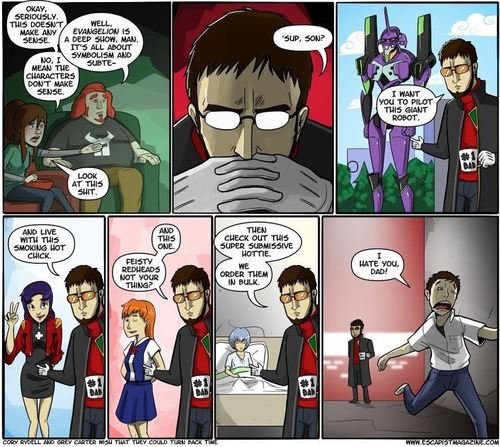
C: “A Cruel Angel’s Thesis” by Yoko Takahashi.  “A” and “The” don’t count.  But this is the opening of Neon Genesis Evangelion, which reminds me of Shinji, who reminds me that it’s okay to write characters you know some people are going to hate.  Because I love to hate Shinji.

Get+in+the+goddamn+robot+shinji+neon+genesis+evangelion+in_8a24b3_4672778
She’s not wrong.

D: “Did You Hear the Rain?” by George Ezra.  It’s a new addition for my list, but it’s awesome and that’s enough of a reason.

E: “Eres Tu” by Kany Garcia.  Because sometimes you just need a bouncy song when you’re slogging through the tedious parts of stories.

F: “Float On” by Modest Mouse.  To remind me make everything worse before it gets better, but to have my characters take most of it in stride.

G: “Girl Anachronism” by the Dresden Dolls.  The song is great, but anachronisms are bad in stories.

H: “Hiai to Melancholy” by Matenrou Opera.  No special reason.  It’s just lovely.

I: “I Come with Knives” by IAMX.  For all those weird scenes that you sit there going “what the hell is wrong with this person?” as you write them.

J:  “Just the Way You Are” by Bruno Mars.  Because sometimes I have to remind myself that I originally liked these characters for some reason.

K: “Kraam” by Bodyslam.  A soothing Thai song is always appropriate.

L: “Love Me Dead” by Ludo.  Because sometimes I have to write about unhealthy and creepy relationships, but Ludo makes it fun.

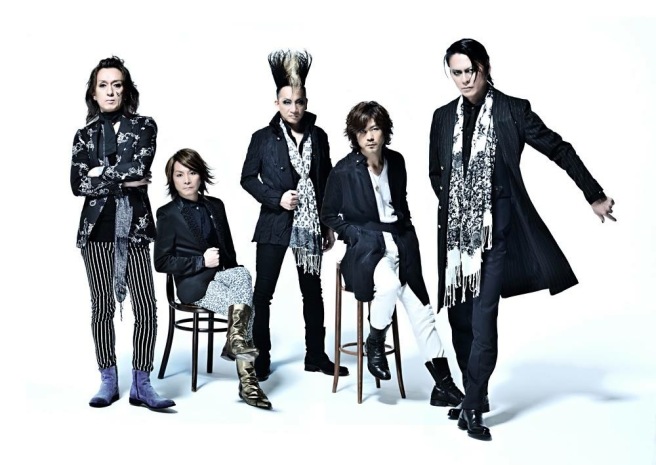
M: “Muma -the Nightmare-” by Buck-Tick.  Because Buck-Tick, that’s why.

015
What’s not to love about Buck-Tick?

N: “Neo Universe” by L’arc en Ciel.  Upbeat for all the happy moments, rare as they may be.  Plus, they have Hyde-san.

O: “Odd One” by Sick Puppies.  Because everyone needs moral support sometimes.  Even the voices in your head.

P: “Postcards” by James Blunt.  For the sappy scenes.  I swear.

Q: “Quitter” by Edgewater.  Sometimes rage is needed in stories.

R: “The Rest of My Life” by Less Than Jake.  To remind me to include internal conflict as well as all the fun stuff.

S: “Sympathia” by Versailles.  Just because I really like it.

T: “Thank God I’m Pretty” by Emilie Autumn.  To remind me that even the luckiest of my characters need to have issues.  Everything, even beauty, has a downside.

U: “Ugly” by the Exies.  Because sometimes I forget how to do teenage angst.  Songs like this help me remember.

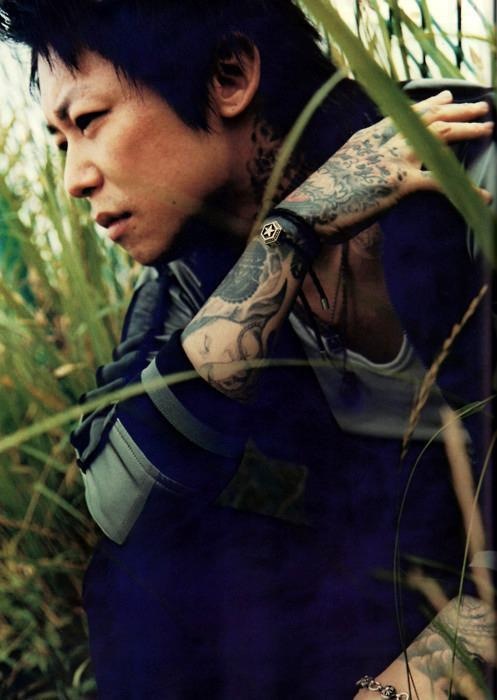
V: “Vinushka” by Dir en grey.  Creepy, rage, dark, disturbing.  That’s the kind of stuff Diru is helpful with.  Also, beauty and depth.

006
Plus, Dir en grey has Kyo-san.

 W: “Wolfen (Das Tier in Mir)” by E Nomine.  Epic music makes for epic stories.  Also, werewolves.

X: Xanadu by Moi dix Mois.  It’s actually the only song on my computer that starts with x.

Y: “You Can’t Be Missed if You Never Go Away” by Cobra Starship.  In other words, heed that call to adventure and leave me alone.

Z: “Zakuro” by Vaniru.  It’s another one of those that I just like.  I don’t know the words, so I can tune it out if I need to in order to write.

What are some of the songs that usually go into your writing or painting or whatever other creative outlets you pursue playlists?  Feel free to share some links in the comments or on my social media pages.  And don’t forget to suggest some blog topics or ask me some questions if you have any.

See ya!

Writing The Personal: Anything But That

Hello, hello!  I really had no idea what to write about today, so I went through a bunch of those list type blogs of “topics for writers,” which usually aren’t all that helpful.  One question that seems to show up on all the lists is “what’s the hardest thing you’ve ever written?”  You mean aside from all of these blog posts?  I don’t know.  I’ve never had a difficult time with any particular piece beyond the normal troubles a writer has.  I’m uncomfortable writing in the field of science fiction and pretty much anything with a political theme, but only because I’m not used to those genres.  There’s really only one thing I actively avoid in my every day writing: anything personal.  I mean yeah, there’s always going to be a part of me in everything I write, but I’ll probably never write a memoir or anything like that.  I’m boring.  Who would want to read about my life?

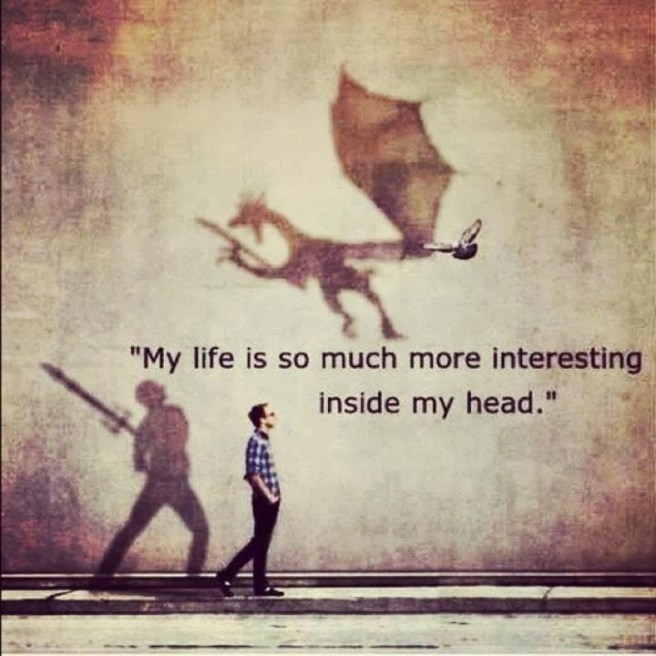
Fantasy-Vs-Reality
That’s why I don’t write about myself.

I don’t care for slice of life books.  Or diaries.  Or journals.  Never have.  My life sucks enough, so I’d much rather escape into fantasy and the like when I’m both reading and writing.  Happy endings aren’t entirely necessary, but adventure and magic and awe are.  I’ve felt that way for as long as I can remember.  I’ve never really kept a diary or journal or anything like that for the same reasons.  I tried.  But it got really boring really fast.  Every diary devolved into a list of shows I watched or songs I heard.  I’m sure that type of writing is cathartic for some people, but I always preferred to avoid it.

Of course, there were times I was forced to write from a personal perspective.  You can’t take poetry writing as an undergrad without being “encouraged” (read: coerced) into writing about yourself.  I always felt dirty after it.  Especially if it was something I had to share with the class.  All the words sounded stupid as I said them out loud.  I either felt like I was bragging or complaining, both of which are things I try to avoid most of the time.  At least back then I avoided them.  I’m just an uncomfortable topic for me.

tumblr_m487hkV83u1r2eae8
Basically.

I still remember one assignment from my Introduction to Poetry Writing class that I ended up taking much more seriously than I ever intended to.  The writing prompt was along the lines of something as simple as “write a poem speaking to God” with the caveat that we had to take a cliché and make it our own.  We sat in a circle and somehow I ended up having to read last.  Everyone else wrote vague and super happy poems, then it came to me.  I didn’t even print out a copy because I didn’t want my mom to read it (she was snoopy like that).  I memorized it and offered to email it to the teacher who totally understood.  It was angry and personal and I have always thought of it when I thought of things that were difficult to write.  It’s part of the reason I started actively avoiding personal writing.

if-you-talk-to-god-you-are-praying-if-god-talks-to-you-you-have-schizophrenia1
Seemed appropriate.

What about you?  What’s the hardest thing for you to write about?  Is there a topic or genre that you actively avoid?

And, for anyone wondering about that poem, here it is:

Dear God

by Shawna Borman

I want to believe
That love is blind
And the world is kind
And that we all have time
To fall in love. 

But that’s a lie. 

I want to be loved
For who I am
Despite what I am
By someone who doesn’t give a damn
About the outside. 

But that’s not going to happen. 

I want to thank you
For saving me
From who I know I would be
At the price of not letting me be free
To make my own mistakes. 

But I can’t. 

Because…

I want to be beautiful.
I would be.
I could be.
I should be!
But this, this isn’t a matter of “shoulda, coulda, woulda.” 

I want to walk
With my head held high
And turn the eye
Of every guy
In the room towards me.

I want to be shallow.
I don’t care if they love me for what’s on the inside,
Because first they have to like me for what’s on the outside.
If the outside’s not for keeps,
No one’s going to want to dig too deep. 

And I want to hate you
For the way you made me.
But I don’t know your face,
Don’t know your name,
Hell, I don’t even know if you exist. 

But I need you to be a part of my life,
Because even though I blame you,
It’s still easier
To believe that I’m one of your creatures,
Than to know that I’m just a freak of nature.

How Role Playing Made Me A Better Writer

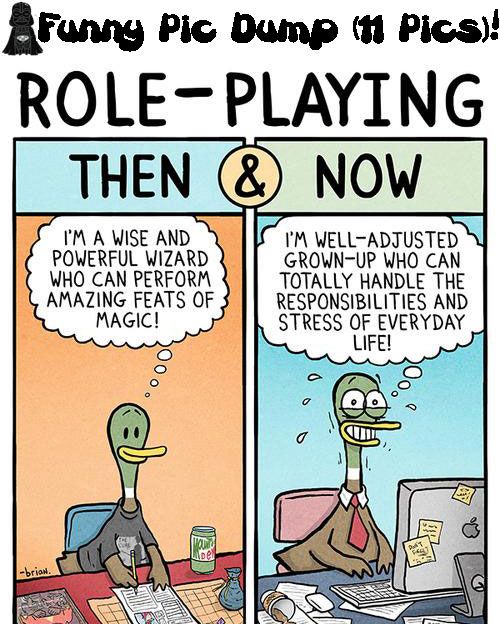
Howdy howdy!  A friend of mine from the Yahoo chatroom days has been talking about “the old days” (hard to believe it was ten years ago) when we stayed up all night talking and (usually) participating in multiple role playing scenarios.  Not MMORPGs or Magic or D&D or any of that.  We mostly stuck with the chatrooms and a few forums.  Stuff like that.  I admit I wasn’t a hardcore RPer.  I didn’t know all of the rules and different styles (single lines versus paragraphs and all that), but there were a few worlds I enjoyed hanging out in.  Anyway, I got to thinking about those days too and realized that they helped turn me into the writer I am today.  Here are the three main ways RPing helped make me a better writer:

de8e19f69e3eb33be4ad569af35702a7
And better at faking my way through adulthood.

1.  The fact that it actually made me write.  I’ve never been very good about writing without deadlines, so I didn’t write much when I wasn’t in classes.  Rping with people forced me to exercise the creative parts of my brain on a regular basis even outside of school.  We built worlds and characters with words.  Then, we put those characters through hell.  And we usually invented a bunch of disgusting weapons to push everything even further.

2.  It taught me a lot about character and world building.  There was nothing worse than getting into a scenario and having a character “magically” beat the crap out of someone they should’ve been pulverized by.  No, your character did NOT spontaneously gain the ability to shoot fire from her palms with no lead up to it.  Take your beating like a man.  Then there were the people who randomly put hiding places in already established open areas with no cover.  Really?  The importance of adhering to established world rules and character attributes was not lost on me back then.

BxG Colored copy
An old character of mine.  Drawn by the aforementioned friend and colored by me.

 3.  I think the most important aspect of RPing is that it’s collaborative.  I’m still not big on group projects, but it taught me how to work with other creators to make a world that combined our ideas.  We had to work together or else everything fell apart due to petty bickering.  Or, if we managed to create a world, but we didn’t agree on things, wild inconsistencies would pop up in the stories.  We didn’t have to stifle our individual voices, we just had to blend them together.  It makes the whole idea of future collaborations a lot less repulsive.

tumblr_nqs988gGlb1rr44ybo1_500
Like “Didn’t we just go over that?”

 So yeah, RPing really did help me become a better writer.  I keep telling my friend that, while I miss the chatroom days, I still kind of RP, I just do it solo now.  That’s what writing is: building worlds and characters, then putting them through hell.  A solo RP.

What about you?  Did you ever RP?  Do you still do it?  What would you say it taught you about writing?  Feel free to share your thoughts on the subject here or on one of my social media pages!

Until next time!

Changing of the Seasons: A Flash Fiction Piece

Hello, hello!  I didn’t really have anything to blog about today, so someone suggested that I post a flash piece inspired by the pictures I post on Mondays (follow me on Facebook, Twitter, or G+ to see the posts).  I decided what the hell, I’ll try it.  I picked a picture and wrote the following piece.  It’s a first draft, unedited, so keep that in mind.  I will admit that I like the idea, but I’m not sure that flash is the right format for it.  Maybe a short story?  Feel free to offer constructive criticism and feedback.  What format do you think would work best?  Advice.  Or just a quick “it sucks/rocks” works too.

11204016_839188969469365_7654394586329462149_n
Photographer: Peter Brownz Braunschmid

Changing of the Seasons

Autumn leaves swirl and twirl on a breeze tinted with the scent of blood. The lifeline of thousands seeps through the soil, bathing and nourishing me as it beckons for my awakening. They pray to me, the mothers and daughters and sisters of those lost at war. Why me? Because only a woman will understand their suffering. The men pray to Him for victory, for the ability to rule, no matter the cost. But the women, they simply ask for peace. They don’t realize how peace is achieved, they don’t know what they’re truly asking for. Still, I will soon be able to grant their wish.

Once every five thousand years, as the ground becomes inundated with spilt blood, I will inevitably rise from the roots of the Mother Tree as Fall passes into Winter. The changing of the seasons allows my release, for I cannot be freed while the Mother Tree lives. Their blood slowly poisons her until she can no longer survive the first freeze. I bide my time, soaking in the nutrients they provide while the tendrils that bind my wrists slowly weaken, becoming as brittle as the dead leaves clinging to the Mother Tree’s branches.

The days pass as if each second has morphed into an hour, but it is almost time for me to rise. To bring peace back to this chaotic world. Their cries grow ever stronger. Peace. Victory. Whichever will put an end to the suffering.

Fear not, my little loves. A new day is coming. I have heard you.

Finally, a twist of the wrist shatters my shackles. Fingers pale as sun-bleached bone are free to break through the slush of soil and blood and ice crystals. The air up here is thick with a metallic, rotten scent. The frigid temperatures haven’t had time to wash away the aroma of death. It’s invigorating. Mixed with the pleas for help, some might call it downright orgasmic.

I know what I have to do.

Near the Mother Tree is a spring. I must bottle the icy water as the full moon strikes it. I will take this gift to the children of the nearest town. Once they drink of it, a deep sleep will overcome and protect them. Then, I will feed. First, the women, unprotected in the fields and the shops. The children unaffected by the elixir will come next. Lastly, those on the battlefield. I will rid the entire world of the agony perpetrated by humanity.

Once the world has been purged of this plague, I will return to the slumbering children. They will awaken and I will raise them as my own. I will teach them compassion and respect and compromise. Peace and love will reign for many years to come.

And when they no longer need my assistance to survive, I will dig my toes deep into the ground on a pleasant Spring evening on the edge of town, where I will transform into the Mother Tree. My branches will reach out to protect my children even as future generations forget my teachings. As they inevitably devolve into a world of bloodshed once again. All the while, the mothers and sisters and daughters will pray for peace, which my next incarnation, growing among my roots, will provide.

Craft Books And Why We Need Them

Hello, hello!  A few days ago, I was bored and skimming through Facebook when I came across a friend’s post about how she had finally gotten back to writing after a pretty long break.  Being bored makes me nosy, so I read through the comments and noticed someone who is admittedly new to writing ask for some tips on how to improve her writing beyond practicing each day.  Let’s be honest, practicing every day is great, but if you don’t know the basics and how to push yourself beyond your limits, you’re not going to get very far.  How do you learn the basics of writing?  Surprise!  There are instruction manuals for basically everything, including writing.  We just happen to call them craft books.

b715df48edb773186527c2810fceb6e2

If you’re like me, you despise craft books because all of your English professors made you read the most boring literary ones they could find.  When you just want to write about demons and serial killers (or dragons and fairies for the fantasy crew/aliens and far away galaxies for the sci-fi crew/etc.), these books get old fast.  So, here’s my quick list of crafty type books for genre writers.

1. The Writer’s Journey: Mythic Structure for Writers by Christopher Vogler.  It’s based around Joseph Cambell’s Hero’s Journey (the basic structure of Western mythology and the different archetypes of the characters and all that).  My favorite part is that it’s aimed specifically at genre writing, so you won’t run across any random derogatory remarks about your chosen field like I have in other craft books.

2. Eats, Shoots & Leaves: The Zero Tolerance Approach to Punctuation by Lynne Truss.  I don’t care if you’re the smartest grammar Nazi in the world, we all need a little help with punctuation sometimes.  If you like dry British humor and concise explanations, this is the punctuation rulebook for you.  Yes, there are certainly more comprehensive and technical books out there, but unless you’re an English professor or an academic writer, I don’t really find them necessary.

3. Save the Cat: The Last Book on Screenwriting You’ll Ever Need by Blake Snyder.  Okay, so it’s not your traditional craft book, but it’s helpful with things like structure and dialogue.  Plus, it might just encourage you to try your hand at screenwriting.  It’s one of those books that explains a lot of the same things traditional craft books cover, but it comes at them from a different perspective.  So, if other books aren’t working for you, give this one a shot.

4. Danse Macabre by Stephen King.  This one is more of a history of horror than it is a craft book, but there’s a ton of useful information in here for horror writers.  I’ll also mention that On Writing by King is supposed to be a wonderful, more general craft book if you’re not looking for something specifically horror related.  I haven’t read the latter yet, but it’s on my to-be-read list.

5. Writing Fiction: A Guide to Narrative Craft by Janet Burroway.  I have no idea which edition I read (I believe it was the 8th), but I do know that she insinuates that genre fiction is common and lowbrow while lauding literary fiction.  Why would I suggest this book then?  Mostly because the writing exercises were worthwhile.  Plus the technical parts are short and to the point instead of super repetitive.  So, if you want a decent version of the undergrad go-tos, pick this one up, just be prepared for derogatory remarks toward genre fiction.

 I’m sure I forgot a lot of great craft books, and I’m definitely trying to forget a lot of bad ones, but I think this is enough to start with.  What about you?  Do you have any favorites that aren’t on this list?  Do you think they’re important to keep around even if you’re a seasoned writer?  I admit to selling most of my undergrad craft books, but I’ve kept all of the ones from Stonecoast (even the ones I hated), because there’s always something they can teach you.

Three Things Not To Say To A Writer

Hi again!  Lately, I’ve been seeing those lists of things that every writer supposedly hates to hear and decided to make my own.  It’s relatively short compared to the ten, fifteen, even thirty item lists I’ve noticed floating around.  This is mainly because 1) I don’t really pay much attention when I start to get annoyed by a conversation, and 2) people don’t generally ask me if I have a real job when told I’m a writer (I’m guessing that has something to do with the whole cripple thing, which I’m okay with), so I run into a lot less annoying people than the average writer.  So, here’s my very short list divided up into who shouldn’t be saying it.

nove
You wouldn’t be my first victim.

 1.  Publishers to writers (or any creative artists really) – “We won’t pay you, but you’ll definitely earn some exposure by being published here.”

If I wanted to work for exposure, I’d post my work on my blog.  I suppose that’s my “popular fiction” training talking.  We’re taught to start at the top (pro-paying publications) and work our way down (semi-pro, token, and as a last resort, exposure) until we receive an acceptance or run out of places to submit to, which makes sense to me.  Why not aim high?  The worst that can happen is a rejection.  I admit that I’ve submitted to non-paying things before, but they were special circumstances.  Even if I kind of understand it, I don’t really see the draw of “exposure.”  And I don’t know why we (creative artists) keep accepting it as if it’s a form of payment.

tumblr_nj1z6nmBh81u39o7oo1_500
This.

 2. Non-writers to writers – “You should write my life story! *proceeds in telling life story*”

Don’t get me wrong, there is probably some CNF writer somewhere who would be totally down for something like that, but I’m not that person.  Unless your life involves dragons or fairies or (literal, not figurative) demons, the chances of me writing about it are pretty slim.  So, maybe this one isn’t exactly a “don’t say it to any writer” thing as much as it is a “know your audience” type thing.  Ask us about the type of stuff we write, then if you’re actually interested in having your story told and that writer seems interested in telling it, go for it!  But, if it’s not something you’re truly interested in doing and/or the writer doesn’t write that type of stuff, it’s probably safer to not bring it up.

3.  Writer to writer – “You’re still working on that piece?”

tumblr_mxyjbtQZJT1qhdvf5o1_500.gif
You really better be ill if you’re a writer and you’re asking me this.

 Yes, yes I am still working on that piece.  The question itself isn’t all that bad.  I don’t get bothered when non-writers ask it, because most people don’t understand what all goes into something like a novel or poem or short story.  But when a writer asks it, it comes across as rude.  I’m sorry I’m not as fast a writer as you.  I’m sorry I hold my work to higher standards.  Go worry about your own work and leave me to my process.

Those are my three big writerly pet peeves.  There are others, of course, but the annoyance levels all really depend on who says what when.  What are some questions or statements that grind on your writerly nerves?

Writing Challenge Turned Q&A

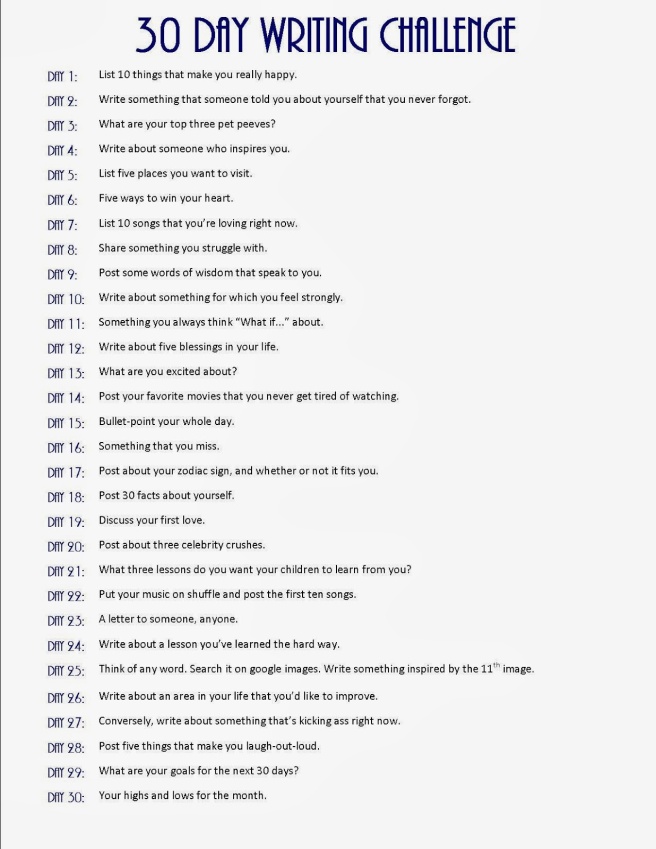
Hello again!  It’s that time of year again, where people start posting those weird “30 Day Writing Challenge” things.  They always sound like a fun idea and every time I see one, I say that I should do it, but then I read the “challenges.”  Honestly, they’re rarely creative and most often read as a list of Q&A topics.  So, since I’m running low on things to ramble about, I thought I’d post one of these challenges here and let you guys pick a number between 1 and 30 (only one number per person, so choose wisely)!  Each week, I’ll do one of the challenges you guys pick.  I can think of a few people who will participate, so this should keep me busy for a few weeks at least.

30-day-writing-challenge-1
It was the first list Google came up with.  Pick a number and I’ll do the corresponding exercise!


To start this off randomly, I asked a friend to pick a number, but to be fair she had no idea why I asked and hadn’t seen the list, so she gets another number if she wants.  Anyway, she chose 29.  I suppose that means that I’m talking about my goals for next month!

Honestly, I don’t really plan that far ahead.  I have trouble making up weekly goals, let alone monthly.  I have my writing goals (which I’ve been struggling with).  I’m trying to write at least 4,500 words a week, so I’m aiming for around 18,000 words for April.  Otherwise, I want to post consistently on my author pages and of course do the weekly blog.  I also want to finish the book I’m reading in the next couple of weeks.  That’s about it, really.

5354927497_b50558716e_z
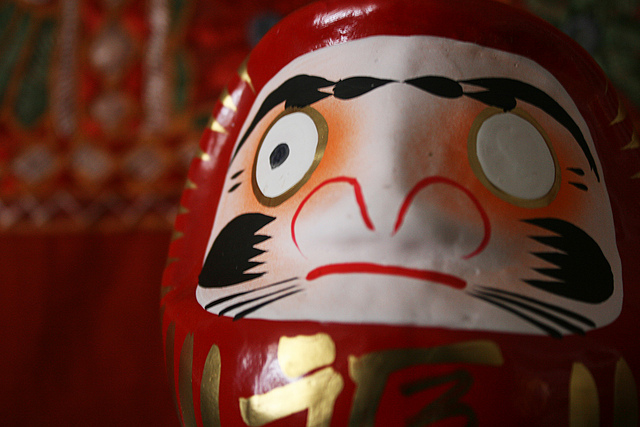
Maybe I should use a Daruma doll for my goals.  I have a blank one somewhere.


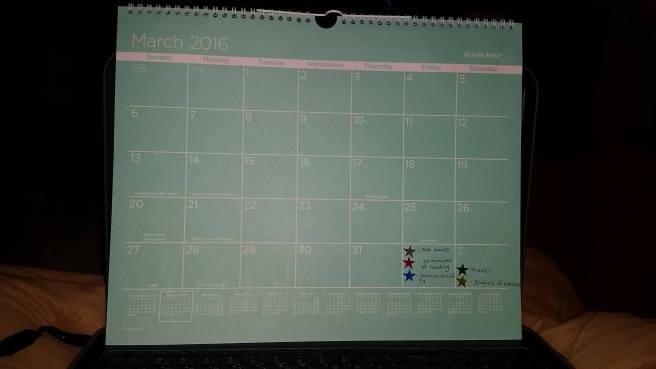
If you’ve been stalking me, you know that I’m also trying to be better about keeping in touch with people.  It’s not an easy thing, but I’m going to keep working at it.  I did talk to someone last week about creating a daily goal calendar, though, so socializing does help!  I already keep track of my word count, but it hasn’t been a big motivator lately.  The daily goal calendar involves using stickers to denote certain achievements depending on what you want to accomplish and creating a key  (example: gold star = 500 words, blue dot = half an hour of reading, purple heart = an hour of family time, etc.), then marking down what you do each day.  I’m going to try to create a computer version for April to see if something visual like that helps me.

12916791_273486852983356_6246745458090268754_o
The example my friend sent me.


Anyway, my goals are basically the same as usual, but with a new way to keep track.  That’s all I really have to say on that.

What do you guys think about the whole picking a number thing?  If you’d like to choose one, comment here or find me on social media (Facebook, Twitter, or G+).  I’m looking forward to seeing who chooses what!

See if you next week!