Making Timelines

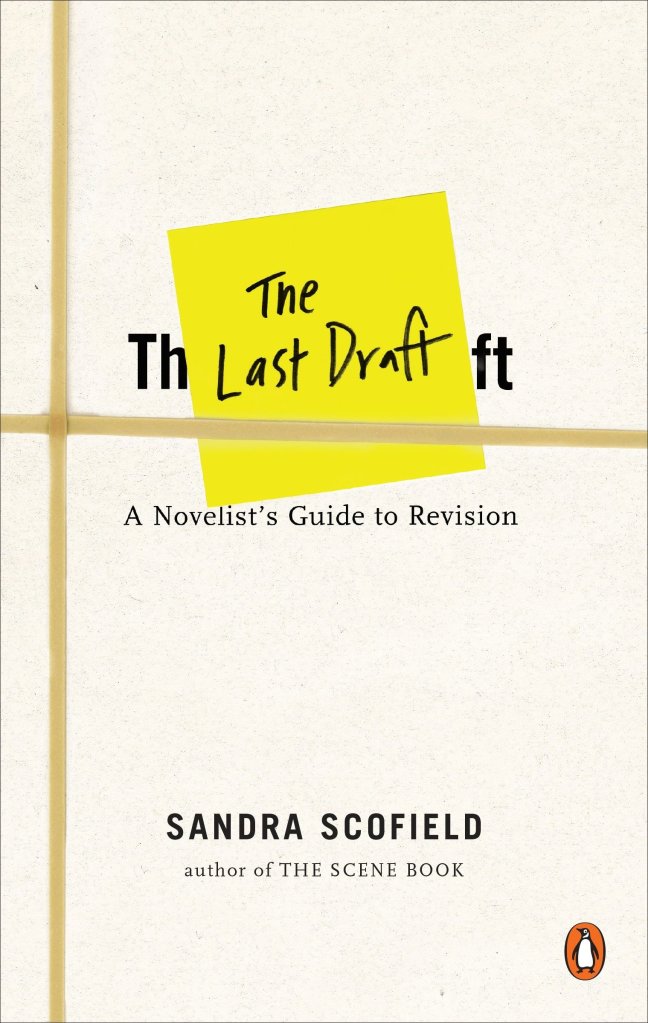
Howdy, howdy!  How is everyone’s August going?  I’m still on track with the goals I posted last week.  Writing and revision are slow, but I’m doing something every day.  As far as books go, I’m currently reading Sandra Scofield’s The Last Draft: A Novelist’s Guide to Revision.  I’m not entirely sure how I feel about it as a craft book.  It’s not bad, but half the time she seems really into genre fiction and the other half it seems like she’s looking down on it.  I’m just getting mixed messages from it.  However, I have found many of the exercises in the book useful!  I wanted to talk about one of those today: making timelines.
91JVoRWVrtL
It’s not bad as far as craft books go.  I’d recommend trying it.

In all of the fiction writing classes I’ve taken, there’s always been at least one hardcore plotter (sometimes, it’s even the teacher).  These are the people who swear by creating outlines and timelines of every little thing before they even begin writing.  I’m not one of them.  Sure, I plot things out in my head, but writing it down feels constrictive.  I like to let my first drafts form organically.  There’s no theme in my mind, no worry about subplots, none of that.  I know point A and point B.  Getting from one to the other should be an adventure.  That’s just how I like it.

I admit that my approach makes revision difficult.  I have nothing but the manuscript to work with, so trying to rework it into something readable can be a daunting task.  That’s why, when someone in my writing group suggested the above-mentioned book, I decided to give it a shot.  And you know what?  It offered suggestions that I had never thought about before.  Did you know that you could write your first draft with no guidelines and then make timelines and outlines and all of that plotter stuff after you have that shitty draft finished?  Because I had never really thought about it.  And now I feel like a complete idiot for not thinking of it sooner.

tumblr_n51kiaVPqc1smcbm7o1_250.gif
Me. Stupid face and all.

So, guess what I did!  I bought a bunch of sticky notes and wrote out the main plotline, filling in stuff and taking stuff away as needed.  In other colors, I took certain characters/groups of characters and wrote out what they were doing and important tidbits that needed to show up in the novel.  Dad stuck them up all over my mirrors and now they taunt me every day until I do my work.  I can’t say I did it correctly.  I didn’t give each little plot point its own Post-It (only the major ones got that honor).  I’m sure I could’ve used different colored pens for different plots and all that crap.  But for my first time, I’m happy with it and it’s working for me so far.
kinopoisk.ru
Why?  Why is this so true?  Timelines as well.  So hard.

I guess what I’m trying to say is that just because you’re not a plotter doesn’t mean you can’t try their techniques during the revision process.  The book offers a lot of different suggestions, some of which I skipped in favor of others.  I’ll read about the ones that I know don’t work for me, but it doesn’t mean I have to do them.  If you’re having trouble finding a toehold in the revision process, pick up a craft book and try something new.  Make timelines.  Use sticky notes or index cards.  Have fun.  See what kind of pretty pictures your story makes.  Or keep it simple like I did.  Whatever works for you.

Speaking of things that work for you (or don’t), how do you go about revision?  Do you make timelines before or after the first draft or not at all?  Feel free to share your thoughts, comments, and techniques here or on my social media pages!

August Goals!

Howdy, howdy!  Can you believe it’s already August?  I feel like I’m still stuck in June.  Time just keeps getting faster and faster.  Am I alone in this feeling?  Yeah?  Well, okay then.  I don’t really have much to talk about at the moment, though I am trying my hand at some revision techniques that are new to me.  If they work out, I’ll probably talk about them more next week.  Anyway, since this Wednesday actually falls on the first, I decided to simply share my August goals with you.

original
It’s a pretty picture.  That’s all.

So, without further ado and in no particular order, I present to you…

August Goals:

1. Submit stuff 8 times (2 every Monday) to semi-pro markets or higher.  This is one of my goals for the year (submitting two stories to magazines or anthologies every Monday) and I’ve been doing really well with it.  I haven’t missed a week yet, though I do believe I submitted stuff on Tuesday a couple of times.  Sometimes, I’ve dreaded submitting or felt like I’ve submitted everywhere I possibly could, but I pushed through it and found new places anyway.  Hopefully, I’ll be able to keep it up!

2. Write 50+ words OR revise 1+ pages EVERY DAY.  I’m back to the small goals every single day thing.  It’s just really helpful to me when I feel like I’m between projects.  In my head, I know I’m prepping for in-depth revisions on LR, but if I don’t keep track of words or pages, I don’t feel productive.  This goal might change once I find my rhythm with LR.  For now, though, it’s good for me.

large
George R. R. Martin

3. Read 2 books.  This is another one of my goals for every month this year.  Honestly, I’ve kind of lost track of how many books I tend to read in a month because some overlap months and others I deliberately read over a longer period of time (almost always craft books).  But I do know I’m up to 18 books this year (thanks to GoodReads tracking feature), so I’m ahead of schedule.

4. Make time for people.  I’ve been a bit reclusive recently, though I still try to answer every message I get.  I just don’t initiate as many conversations as I should.  This is nothing new.  It’s something I struggle with all the time (as you know if you’ve read earlier posts).  I’m just far too comfortable not talking to people and stalking them on Facebook instead.  Yes, I’m creepy like that.  My friends know this and many of them do the same.  But I really do want to be better about socializing.  I swear.

5. Finish timeline for LR.  This is one of those new-to-me techniques I mentioned earlier.  There’s about one more day’s worth of plotting before I have a timeline that I can work with (I’m plotting it on the computer before I write anything out).  I even bought a bunch of Post-It notes in pretty colors to make everything easy to differentiate.  I just have to figure out where to stick them that’s easy to see.  Then, I have to recruit Dad to do the sticking.  I bet he never thought my novel writing would include work for him.

Habitación-de-los-post-it-destacada-600x600
That’s a lot of Post-It notes.

6. Work on revisions of LR.  Hopefully the timeline will make revisions go more smoothly than usual.  It’s already given me ideas for new scenes and how to rework some old ones, so I’m cautiously optimistic.  I should have some updates on this in the next couple of weeks.  Wish me luck!

Those are my goals for the month.  What about you?  What are you hoping to accomplish before September?  Feel free to share your goals or thoughts here or on my social media pages!

Thoughts On THE WICKED DEEP

Hello, hello!  It’s the last Wednesday of the month already.  Time flies when you’re having fun (or just going about daily life), I suppose.  Anyway, you all know what happens today: a book review!  This week, I’ll be talking about The Wicked Deep by Shea Ernshaw.  It was published back in March of this year by Simon and Schuster.  I read it with the reading group I’m in and decided that I have too many thoughts about it to not write a post.  I usually try to keep my posts as close to spoiler free as possible (sometimes a couple will slip through), but that’s going to be impossible here.  Spoilers this way lie.  You’ve been warned.

35297394
I absolutely love the cover.

The Wicked Deep is the story of a small town called Sparrow and the curse that has plagued it every summer for two centuries.  Why is there a curse?  Because the town sentenced three sisters to death by drowning for acts of witchcraft, of course.  What is the curse?  The three sisters possess the bodies of three girls from the town and lure boys to their death in the harbor.  Poor Penny, a seventeen-year-old who lives on an island with her not-quite-all-there mother, has accepted that it’s the town’s fate to suffer the wrath of the witches every year.  That is until Bo, an unwitting outsider, shows up and she decides it’s her mission to protect him.  Things go all kinds of wrong from there.

I have to admit that I was totally in love with this book as I was reading it.  The setting was wonderful and the writing pulled me along.  Even after I finished it, I was prepared to give it five stars.  Then, I took a breath and started thinking about it.  Really thinking about it.  That was when things got super dark, and not in a good way.

Escalated quickly
It really did.

*spoilers ahead*

I ended up feeling sooooo bad for Penny. First, she’s possessed by Hazel (violation much?), but then there’s the whole Bo thing. I mean, there’s sex.  That means Penny is basically ghost roofied and forced into sex without any say. To be fair, Bo doesn’t know about Penny being Hazel at first.  But after everything is over, he keeps dating Penny like everything is normal and he was in love with her all along. At the same time, he keeps pining over Hazel. So, he’s not in love with Penny, which means she’s stuck in a relationship with some guy who’s not really into her.  It all just got very rapey the more I thought about it.  By itself that’s fine (not every story has to be a happy one), but there will be people who think this is a great love story and that’s what really makes me sad.

3cd8a33a
Me after really thinking about things.

Aside from that, I also expected more from Penny’s mom.  She supposedly has some kind of psychic powers and knows when people are on her island and all that, but she doesn’t kick Hazel’s ghostly ass?  She doesn’t really do much at all.  It’s apparent during her conversation with Hazel that she knows things, but she doesn’t act.  It was just a little disappointing.

Ultimately, I had a love/hate relationship with The Wicked Deep.  I’ll still keep a look out for other books by Shea Ernshaw, though.  It was good enough that I was swept along, which makes it worth looking into other stories by her.

starstarstarstar outlinestar outline

Overall, my issues with it dropped my rating down to a 3 out of 5.  I definitely suggest picking it up if you’re into stuff like that, but really think about the story.  Maybe I’m making too much out of something small.  Maybe you’ll find it creepy too.  Who knows?

Impromptu Celebratory Post

Howdy, howdy!  I know, I’m not supposed to be posting today.  But there’s something I wanted to celebrate now that Dad has finally given me the go ahead.  And since next week is a book review post, I thought I’d just write this one as something special in between.  First, say hi to Dad from my Stonecoast years!

248634_10151728882250166_947589524_n
Pretty sure this was January 2013.

That was when he was around 270 lbs.  He maintained that weight for a while after losing 60 lbs (yeah, he was 330 at one point).  Then, a week or so after Thanksgiving last year, we went to see a new doctor who came into the room and immediately said Dad was dying because of his weight and diabetes and all that stuff (dude was a real ray of sunshine </sarcasm>).  So, he told Dad to lose 70 lbs through diet and exercise.  He gave us a crappy little paper that showed what the diet would consist of (not helpful at all), said to do 30 minutes of cardio a day, then sent us away to figure everything out ourselves.

So, we did.

The doctor said 1,200 calories a day, so I found an app to keep track of that.  Dad got a new Polar A370 watch to track his exercise and that H10 heart monitor we posted about a while ago, plus the corresponding apps.  And for almost 8 months (November 29, 2017 until July 18, 2018), Dad religiously stuck to between 1,200 and 1,300 calories a day.  The calorie app would yell at him if he was under 1,200 because, for men, that’s considered starvation levels, but he rarely went over 1,250.  He walked on the treadmill 6 days a week and did some strength training as well, but had to give up the exercise for a few weeks when the doctor put him on a statin and he had some adverse reactions.  It was hard work and I’m super proud of him!  Say hi to Dad now!

2018.07.19(SLB1)
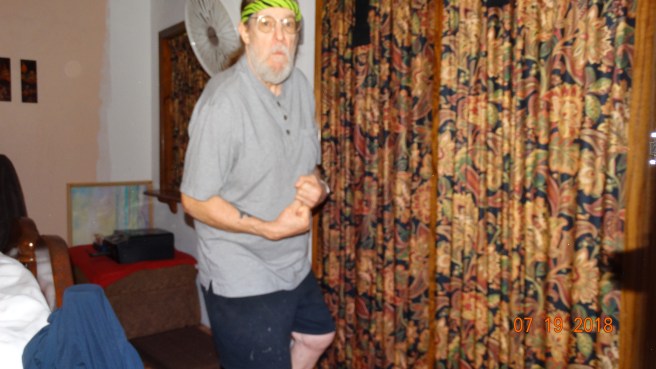
He’s strong like bull.
2018.07.19(SLB2)
A dorky bull, but still.
2018.07.19(FVT)
He also made the curtains, in case you were wondering.

He’s lost about 80 lbs!  He weighed 191.1 on the 18th!  He went from a 2X down to a large.  He bought a new belt a few months ago and is currently in need of another new one (he’s been drilling extra holes into it as needed for now).  He did an awesome job!

Now, we’re slowly figuring out a maintenance plan.  That’s all.  I just wanted to brag about Dad a bit.

See you Wednesday!

Smashed Cucumbers and Grilled Lamb-Stuffed Pitas

Hello, hello!  First and foremost, HAPPY BIRTHDAY, DAD!  Yup, it’s the anniversary of his awesomeness as a few of my friends call it.  If you have his number, call him and sing at him.  Otherwise, post birthday wishes here or on my social media pages and I will pass them along.

Birthday Cake - candles
Opus and Bill say happy birthday!

And now, onto the blog.  I have nothing new to talk about, so I thought I would post a couple of recipes Dad recently tried out: smashed cucumbers (also known as Pai Huang Gua) and grilled lamb-stuffed pitas with yogurt sauce.  Both of these recipes came from America’s Test Kitchen.  Have you tried something new recently?  Feel free to share your food exploits here or on my social media pages!

9471392dce0f9a604f3501258ea8649b
Borrowed from Google

First up, smashed cucumbers (from season 18, episode 17).  Serves 4.  We forgot the chili oil ATK suggested you use with this dish, but it was good without it.  Nice and cool and refreshing, especially on a hot summer day.  Dad also added a teaspoon of minced ginger, which was delicious.

Ingredients:

  • 2 (14-ounce) English cucumbers
  • 1 ½ teaspoons kosher salt
  • 4 teaspoons Chinese black vinegar (or 2 teaspoons of rice vinegar and 1 teaspoon of balsamic vinegar)
  • 1 teaspoon garlic, minced to paste
  • 1 tablespoon soy sauce
  • 2 teaspoons toasted sesame oil
  • 1 teaspoon sugar
  • 1 teaspoon sesame seeds, toasted

Directions:

1. Trim and discard ends from cucumbers. Cut each cucumber crosswise into three equal lengths. Place pieces in large zipper-lock bag and seal bag. Using small skillet or rolling pin, firmly but gently smash cucumbers until flattened and split lengthwise into 3 to 4 spears each. Tear spears into rough 1- to 1 1/2-inch pieces and transfer to colander set in large bowl. Toss cucumbers with salt and let stand for at least 15 minutes or up to 30 minutes.

2. While cucumbers sit, whisk vinegar and garlic together in small bowl; let stand for at least 5 minutes or up to 15 minutes.

3. Whisk soy sauce, oil, and sugar into vinegar mixture until sugar has dissolved. Transfer cucumbers to medium bowl and discard any extracted liquid. Add dressing and sesame seeds to cucumbers and toss to combine. Serve immediately.

ATK_S18_16_Grilled_Lamb_Pita_Burgers_1_t800
Also borrowed from Google.  We had the smashed cukes instead of a salad.

Next up are the grilled lamb-stuffed pitas with yogurt sauce (from season 18, episode 20).  Serves 4-6 (the following instructions are for 4 servings, but just add extra pitas and divide mixture by 6 if you want to serve more/have fewer calories).  The pita was crispy, the meat juicy, and the yogurt sauce was nice and cool and creamy.  Definitely worth a try.  Some grilled onions on top might be a nice addition as well.

Ingredients:

SAUCE

  • 1 cup plain Greek yogurt
  • ½ cup minced fresh mint
  • 2 tablespoons lemon juice
  • 2 tablespoons tahini
  • 2 tablespoons extra-virgin olive oil
  • ½ teaspoon salt

SANDWICHES

  • 1 onion, cut into 1-inch pieces
  • 1 cup fresh cilantro leaves
  • ¼ cup extra-virgin olive oil
  • 1 tablespoon grated lemon zest plus 3 tablespoons juice
  • 1 tablespoon ground coriander
  • 1 tablespoon ground cumin
  • 1 tablespoon paprika
  • 2 teaspoons salt
  • 1 ½ teaspoons pepper
  • ½ teaspoon cayenne pepper
  • ¼ teaspoon ground cinnamon
  • 2 pounds ground lamb (or 85 percent lean ground beef)
  • 4 (8-inch) pita breads

Directions:

1. FOR THE SAUCE: Whisk all ingredients together in bowl. Set aside.

2. FOR THE SANDWICHES: Pulse onion and cilantro in food processor until finely chopped, 10 to 12 pulses, scraping down sides of bowl as needed. Transfer mixture to large bowl. Stir in oil, lemon zest and juice, coriander, cumin, paprika, salt, pepper, cayenne, and cinnamon. Add lamb and knead gently with your hands until thoroughly combined.

3. Using kitchen shears, cut around perimeter of each pita and separate into 2 halves. Place 4 thicker halves on counter with interiors facing up. Divide lamb mixture into 4 equal portions and place 1 portion in center of each pita half. Using spatula, gently spread lamb mixture into even layer, leaving 1/2-inch border around edge. Top each with thinner pita half. Press each sandwich firmly until lamb mixture spreads to ¼ inch from edge of pita. Transfer sandwiches to large plate, cover with plastic wrap, and set aside. (Sandwiches may be held for up to 1 hour before grilling.)

4A. FOR A CHARCOAL GRILL: Open bottom vent completely. Light large chimney starter two-thirds filled with charcoal briquettes (4 quarts). When top coals are partially covered with ash, pour evenly over grill. Set cooking grate in place, cover, and open lid vent completely. Heat grill until hot, about 5 minutes.

4B. FOR A GAS GRILL: Turn all burners to high, cover, and heat grill until hot, about 15 minutes. Turn all burners to medium-high.

5. Clean and oil cooking grate. Place sandwiches on grill, cover, and cook until bottoms are evenly browned and edges are starting to crisp, 7 to 10 minutes, moving sandwiches as needed to ensure even cooking. Flip sandwiches, cover grill, and continue to cook until second sides are evenly browned and edges are crisp, 7 to 10 minutes longer. Transfer sandwiches to cutting board and cut each in half crosswise. Transfer sandwiches to platter and serve, passing sauce separately.

Revision Prep: The Initial Read-Through

Howdy, howdy!  I recently started the initial read-through of LR (code name for novel attempt 2, draft 1) in preparation for beginning the editing process.  Yes, I know I should’ve done that a couple of months ago, but I didn’t.  So, here we are.  This is the part of revision where I haven’t looked at the story in a while (about six months for this one), so I’m reading it mostly in reader mode.  I have to remind myself that this is not the time for my inner editor to nag at every little thing, it’s time to just enjoy the story and see how it goes.  However, there are things I keep on the look out for in the back of my mind while I’m reading.  That’s what I want to ramble about today: the five things I look for during this read-through.

Slide2
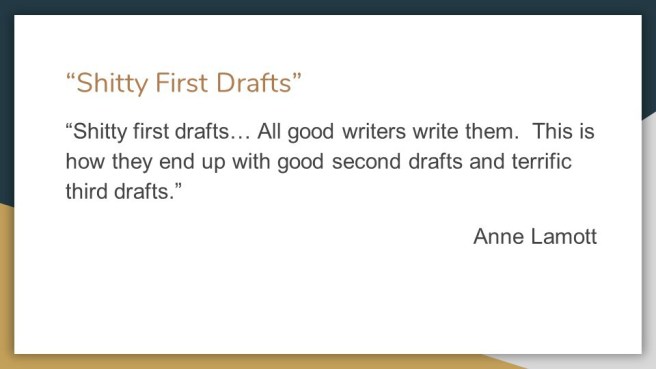
The sooner I acknowledge it’s shitty, the easier it is to tune out my inner editor until I need her.

1. Gut reactions.  What makes me laugh?  What makes me want to cry?  What do I glance over?  I’m looking to see what parts of the story elicit emotional reactions and which parts are blah.  I want to keep the former (if possible) and tweak or get rid of the latter.  Also, I want to know if I still enjoy the story as much as I did when I wrote it.  I’m only like six chapters into LR as a reader, but I’m actually super surprised at how much I love it.  Yeah, it’s a shitty first draft, but the characters and story still really amuse me.  It makes me think I’m doing something wrong, because I feel like I’m supposed to hate it at this point.

2. Continuity errors.  Have I randomly changed someone’s name?  Did I move an entire building somewhere else halfway through?  Was someone right handed and suddenly they’re left handed?  Stupid things like that.  Some are glaringly obvious while others will only be noticed by a really close reading.  I already know my main character randomly goes from fourteen to seventeen (because fourteen was too creepily young for this particular story).  One of my “bad guys” changes her race halfway through because I originally couldn’t decide what group of shifters she belonged to, but then decided on one that was completely different from how I imagined her in the beginning.  And of course there are a bunch of little things as well.

plot-holes-plot-holes-everywhere
I feel like I’ve used this before, but it’s appropriate.

3. Plot holes.  Have I left any threads undone?  Did I randomly start something in the middle with no lead up to it?  Is what the character’s doing feasible in the world I created?  Is it something they actually would do?  These are definitely things I have to make notes about so I can fix them or change them or remove them entirely.  There’s this thing with a fox in the first chapter of LR and by chapter two, it’s been completely forgotten.  I have no idea where that was going, but if I don’t figure it out by the end of this read-through, I either need to cut it or make something up.  These are important changes for me to consider as I read.

4. Useless characters.  Do I have any characters who are just there to do one thing and then they disappear?  Can someone more pertinent to the story do the thing?  Could that character become someone important?  I know most books have at least a couple of superfluous characters, but I like to weed them out if I can.  In LR, there’s the principal’s secretary whose sole job seems to be giving my main character his late slips for class.  I’m debating whether or not to combine her with another character or just giving her a bigger role in the next book.  Then again, I might keep her as she is because that’s life.  Someone has to pass out the tardy slips.

Lucifer1
Went looking for typo demon pictures and got distracted by manga demons.  It’s Lucifer from Kaori Yuki’s Angel Sanctuary.

5. Blatant typos and grammatical errors.  These aren’t things I actually look for in this read-through, but if they pop out at me, I either make a note or fix them.  I try to save this stuff for later read-throughs, though.

What about you?  Do you have anything you look for when you’re getting reacquainted with stories you want to revise?  Feel free to share your thoughts and comments here or on my social media pages!

Happy 4th of July!

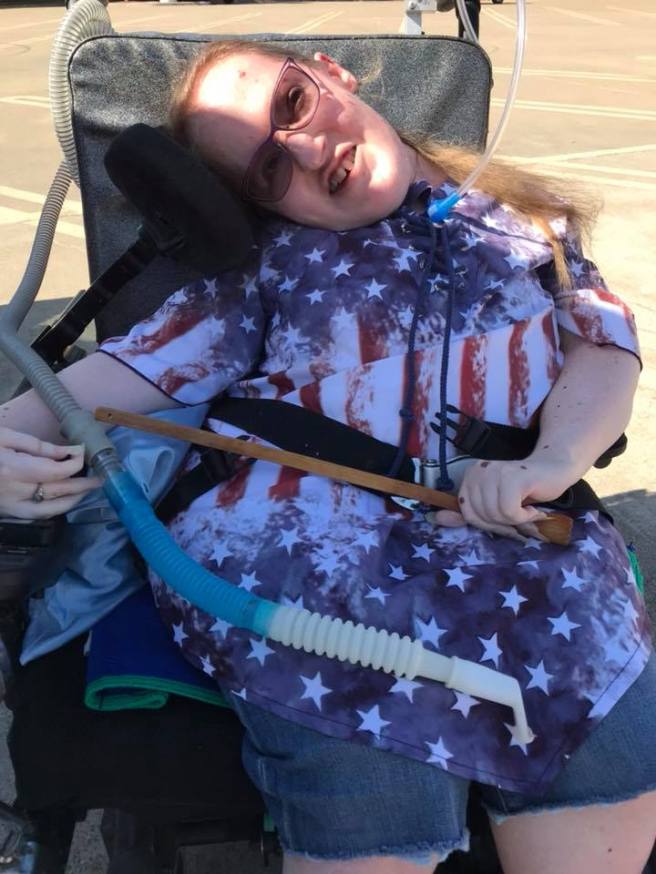
Hello, hello!  I intended to write a blog today (I swear), but ended up procrastinating by running errands with Dad and having a late lunch.  Then, I decided that I’d rather watch Jurassic World or something with him than write a blog.  My rationalization?  It’s a holiday here in the States (or at least it will be by the time this posts), so I can take a day off.  In lieu of a blog post, here’s a picture of me looking all festive.

36627188_10155485571576716_3747119976599781376_n
Dad bought me this shirt!

Whether it’s your Independence Day or just another Wednesday, have a wonderful 4th!  Have fun.  Be safe.  Don’t light too much stuff on fire.  I will be back with an actual post next week!

See you then!

Thoughts On DEATH AND A POT OF CHOWDER

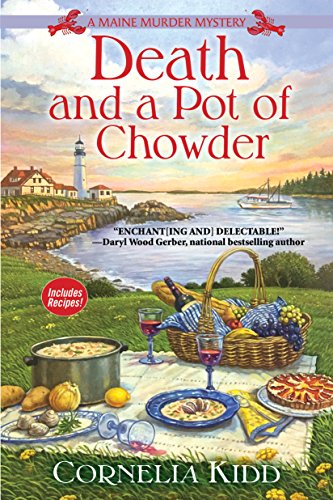
Hello, hello!  It’s the last Wednesday in June, so it’s time for another book review.  Around this time of year, I have a tendency to miss Maine.  I decided to request book one in a new cozy series called Maine Murder Mysteries.  It’s called Death and a Pot of Chowder by Cornelia Kidd and it came out earlier this month from Crooked Lane Books.  As usual, I must thank them and NetGalley for sending me an advanced copy in exchange for an honest and unbiased review.  With that out of the way, let’s get on with it!

617YpVuTEbL
Adorable cover, but I can’t really remember a picnic.

Death and a Pot of Chowder is set on Quarry Island, a tight-knit community focused on family and lobstering.  It focuses on Anna Winslow and her family.  First, she receives a letter from a sister she didn’t know she had who wants to meet.  If that wasn’t enough excitement, she brings Izzie (the sister) home with her only to discover that Anna’s brother-in-law, Carl, was murdered.  Anna is a little resistant to getting mixed up in a murder investigation until charges are brought against her husband.  Then, the fun really begins.

I knew nothing about this book going in, aside from the fact that it was set in Maine, so I had no expectations of it.  That was a good thing, because I probably would have been sorely disappointed in it if I was expecting something.  It was slow moving and just kind of drifted along like it wasn’t in a hurry to get anywhere.  Which isn’t a bad thing.  It gave us plenty of time to get to know the characters and become invested in their lives, though I’m definitely more interested in Izzie than Anna.  I didn’t really empathize with Anna the way I was supposed.  It was mostly because she focused on wanting to know the “dad” who abandoned her rather than being content with the “step-father” who raised her.  I just don’t understand people who are so obsessed with a sperm donor (there’s more to it, but that’s basically what he was).  Especially when a loving father figure is in the picture.  But anyway, I really liked everyone else.

1299293336669_6079883
Sorry, Anna.

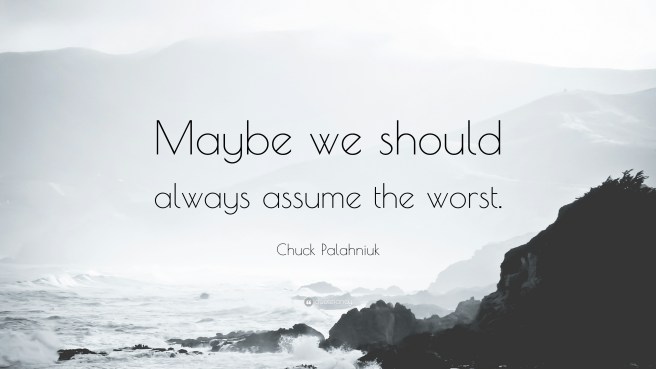
As far as the plot goes, it was one of those where I figured out what was going on pretty early.  The fact that Anna didn’t figure it out earlier was written off as her being too close to everyone involved, but what was Izzie’s excuse?  Was she just too focused on her own stuff to see the signs?  Maybe.  Or maybe I just automatically assume the worst about people.  But just because I knew what was going on, didn’t mean that I was sure about the murderer.  I wavered back and forth between two people until close to the end, so that was nice.  It’s a pretty standard plot, though.

71935-Chuck-Palahniuk-Quote-Maybe-we-should-always-assume-the-worst
Maybe.

The writing was okay.  Like I said, it was slow and drifting.  It was also one of those stories that had to repeat all the clues at least three times, which was annoying.  But the parts about Maine and island life were lovely, so I didn’t mind the rest so much.

Ultimately, Death and a Pot of Chowder was just okay.  If a second one comes out, I’ll probably pick it up because I liked the characters and want to give them a second chance.

starstarstarstar outlinestar outline

Overall, I’d give it a three out of five stars.  If you’re into cozies and Maine, give it a shot.  Otherwise, it’s not going to hurt if you skip over this one.

Types of Real Life People I Kill Off in Stories

Howdy, howdy!  I’d like to take a second to thank Joseph Carro once more for his super helpful guest post last week.  I hope everyone enjoyed it.  And now, for today’s post, I want to talk about some of the different types of people who make their way into my stories.  I’ve actually been a little aggravated lately (I try not to be easily annoyed, but it happens).  So, the different types of people I’m planning to talk about are usually the ones who die in my books and stories.  Painfully.  But don’t worry.  It’s just a cathartic type thing.  I’m not a sociopath.  I promise.

71UK03Jv9HL._SX425_
See?  It’s on a mug.  I’m not the only writer who does it.

Type the first: people who flake on me.  These include, but are not limited to, the people who make plans then “forget” even though you talked to them that morning, the salespeople who make appointments with you then call two hours before they’re supposed to meet you to reschedule because of “conflicts,” and the people who offer to do you a favor then ghost you for six months in the hopes you’ll forget instead of just saying “hey, I can’t follow through, sorry.”  I know, in the grand scheme of things, none of this is really important, but it’s still super annoying.  And I will smile and pretend it doesn’t bother me, but rest assured… I’ve killed far too many people (some multiple times) for doing this stuff.

Type the second: people who insist on treating me like I’m mentally challenged (or whatever the proper terminology is today).  I admit, after it’s pointed out that I’m perfectly capable of thinking and speaking for myself, most people treat me like a human being.  But there’s always that one waiter/waitress who tries to walk away without taking my dinner order despite the fact that I ordered my drink perfectly well five minutes before that.  I even had a professor in my community college who would always act super surprised when I answered his questions correctly even though he didn’t act that way with everyone else.  To be fair, he was a nice guy and I loved his class, but it was a little annoying.  It always is when people underestimate your intelligence.  I don’t kill off this type of person very often, but sometimes it just builds up and I have to release my aggravation somehow.

CBR9_7_AgainReallySupernatural.gif
This face applies to everything here.

Type the third: people who assume I have no life.  These are the ones who call up or text and want to make plans for that afternoon/night.  It’s not so much my friends who annoy me with this crap as it is companies.  And it’s always medical supply companies.  In the past couple of weeks, we’ve gotten two calls from people wanting to come out that afternoon or the next morning.  I don’t wake up until the afternoon.  And it’s a little insulting when they act like I should be home waiting for them.  I have a life.  Okay, I’m usually at home, but that doesn’t mean I’m not busy.  Don’t just assume I’ll be here unless you make an appointment a few days in advance.  And then, don’t flake on me.  If you do multiple annoying things, torture will precede your death.

dont-invite-me-anywhere-last-minute-i-enjoy-doing-nothing-3974635
The Interwebz gets me.

I think that’s enough ranting about the types of people who die in my writing.  Of course, there are many other categories, but these are the ones that spring readily to mind when I think about this stuff.  What about you?  Do you use death in your work as a way to deal with people who annoy you?  What types of people make it into your work most often?  Feel free to share your thoughts or comments here or on my social media pages!

Guest Post: Joseph Carro On Writer’s Block

Howdy, howdy!  Welcome to another guest post.  This time, we have my friend and fellow Stonecoast alum, Joseph Carro.  He’s got some super helpful tips for working around writer’s block, which I struggle with a lot.  So, read on!

106
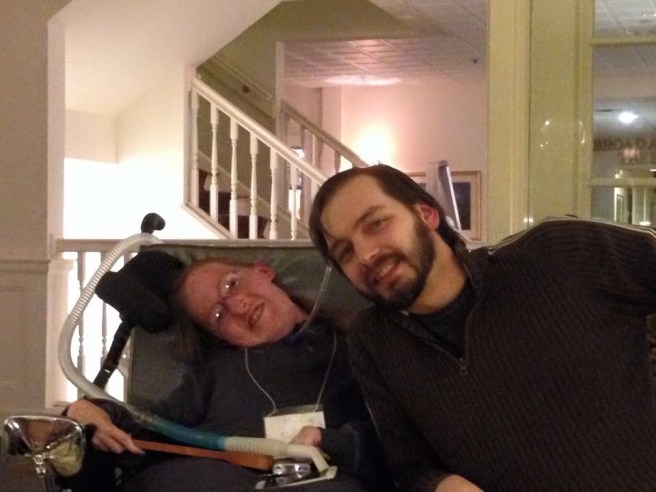
Joe and I at the Harraseeket Inn.  Pretty sure that was January ’15.

On Writer’s Block

By Joseph Carro

Writing can be an extremely frustrating and hopelessly solitary artistic endeavor, and as writers we know and understand this when we choose it as our lifestyle. Yet it doesn’t make it any easier when we’re holed up in the basement, writing the next big thing on our minds. Whether you’re trying to write a blog post, a poem, a screenplay, or a novel – Writer’s Block afflicts us all. I know that personally, real life usually gets in the way and saps my creative juices with its constant demands, but to keep writing I have acquired several techniques which I use in order to get my brain jumpstarted again. My hope is to share a couple of my own techniques with you. I know that many of you have your own techniques, but as a writer – I usually appreciate any new ways in which I can defeat this annoying affliction. Feel free to chime in with your own methods below in the comments section.


WALK OR DRIVE: Walking, to me, is a lost pastime. And I’m not the only one to think so. If you’re stuck on a certain spot in your manuscript or post or what have you, get OUT of that space for a little while. If you don’t like walking, then just sit outside or maybe take a drive. Anything to get yourself out of your stagnant state. Maybe you’ll see or experience something that will ignite that spark. You just have to step outside your comfort zone for a bit. Fresh air does wonders for the mind and the thought process needed for writing.

giphy (8)

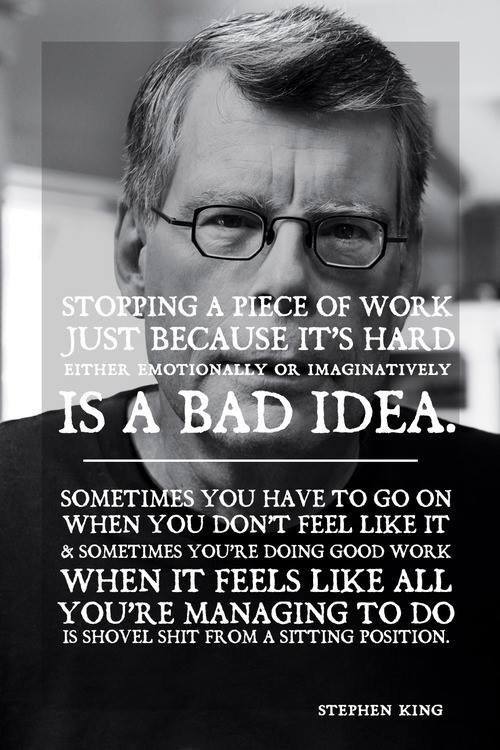
READ SOMETHING: As Stephen King once said; “If you don’t have time to read, you don’t have the time (or the tools) to write. Simple as that.” Writing is a skill in which you absorb technique and inspiration from reading other writers. To do so, you need to actually read. Sometimes, reading someone else’s work is the perfect way to jumpstart your own. In my case, I will sometimes put aside my writing for one day and try to finish the book I was already reading or start another one. By the time I’m through a few chapters, I’m usually chomping at the bit to get back into my writing project. Obviously, it’s “dangerous” to put aside the writing to do something else (because you can get too much into the habit of doing that), but in moderation I think it works. Just really pay attention to what the authors are doing; their prose, the construction of the novel or short story or poem or whatever, and the way in which the strongest parts of it make you feel as a reader. Try to infuse your writing with some of that magic, without trying to ape their style. Be you.

094

LISTEN TO MUSIC: This one is very divisive within the writing community. In one camp, you have people who absolutely cannot listen to music while writing. Or, they at least must listen to very quiet, ambient music rather than anything heady with lyrics. That’s okay, this technique may not be for you either. However – when I’m trying to write a certain scene or a certain tone to my short story or screenplay, I sometimes pick an appropriate piece of music. For a tone, I will generally choose a playlist I’ve created on Spotify or find a playlist on YouTube – for example, if I’m looking for a melancholy tone I will choose a playlist that’s labeled as “sad songs” or “bittersweet songs”. Generally, the mood conveyed through these songs, and the emotions they bring out enhance my writing. It’s all about knowing your tolerance for this kind of distraction while you’re trying to write. This also works if you just need to listen to a song or two BEFORE you write, rather than listening to entire tracks during your actual writing. Just make sure to fire up another song here and there to renew your creative juices and emotions, because sometimes sitting in a chair and writing prose does not automatically generate emotions until you really get into the meat of the story. Writing is both a technical skill and an art, and art comes from emotion. Sometimes, we wade too far into the technical aspects and lose the emotional momentum.

where_words_fail_music_speaks_art_print-r5a683fbc46c54ffe83e696870a409b8e_zv9_8byvr_307

USE WRITING EXERCISES AND PROMPTS: This method is actually my favorite, and thanks to the internet, there are countless online sources for finding writing ideas. These aren’t necessarily meant to replace the project you’re working on, but are more for trying to write something in general when you’re stuck. However, if you need some distance from your novel, it’s okay to take a brief respite and write something else. A few of my favorite sources for writing prompts are from books I’ve found or have been given. My wife gifted me a sort of “activity book” called 400 Writing Prompts by Piccadilly Inc and that one has given me quite a few ideas. A couple of other books I’ve found to be pretty useful are The Writer’s Book of Matches: 1,001 Prompts To Ignite Your Fiction from Writer’s Digest Books, What If?: Writing Exercises for Fiction Writers by Anne Bernays and Pamela Painter, and The Pocket Muse: Ideas & Inspirations for Writing by Monica Wood. There are also lots of online sources out there as I mentioned above, and some of my favorites are Writer’s Digest, Poets & Writers, tumblr, and even reddit. Various bloggers like myself also dedicate entire sections of their blog to writing prompts. My own blog, Away With Words, has just such a section that you can find HERE. I try to do at least one weekly prompt, but sometimes I do more.

13055369_10154016166591291_2581038575776862019_n


These are just some tools for trying to get back into the swing of things, and my hope is that by using these techniques and resources, you can dig yourself out of whatever funk you’re in and get back to writing. Remember – try not to be too hard on yourself. Writing is hard work, it’s thirsty work, and your brain can quickly become parched when it’s dealing with the same tedious task over and over. Give it some variety and keep yourself from getting mired. Good luck!

406072_10150922800201931_1610089937_n

My name is Joseph Carro, and I am a Maine-based freelance writer and editor trying to make it in the big world of letters and semi-colons. I work currently as a barista to (barely) pay the bills, and in the meantime, I’m working on a YA novel, currently untitled, as well as various other works like screenplays, comic scripts, short stories, and flash fiction. Heck, you may as well toss in some comic books with that, too.

I live in Portland, here in Maine – with my beautiful wife and our five-pound chihuahua, Brewtus.

Above photo courtesy of Helen Peppe.