Thoughts on SAVE THE CAT! WRITES A YOUNG ADULT NOVEL

Hello, hello! How’s everyone doing this lovely, toasty day? I ended up with two books to review this month because this one decided to release a week early, so it’s impromptu book review time! It’s a craft book. I don’t know why I chose a craft book, but I did. Mostly because it’s been a while since I read one, I guess. Anyway, Save the Cat! Writes a Young Adult Novel by Jessica Brody was released on July 18th (Dad’s birthday! Happy belated birthday, old man!) from Ten Speed Press. As usual, I must thank them and NetGalley for access to an ARC in exchange for an honest and unbiased review. Let’s do the thing.
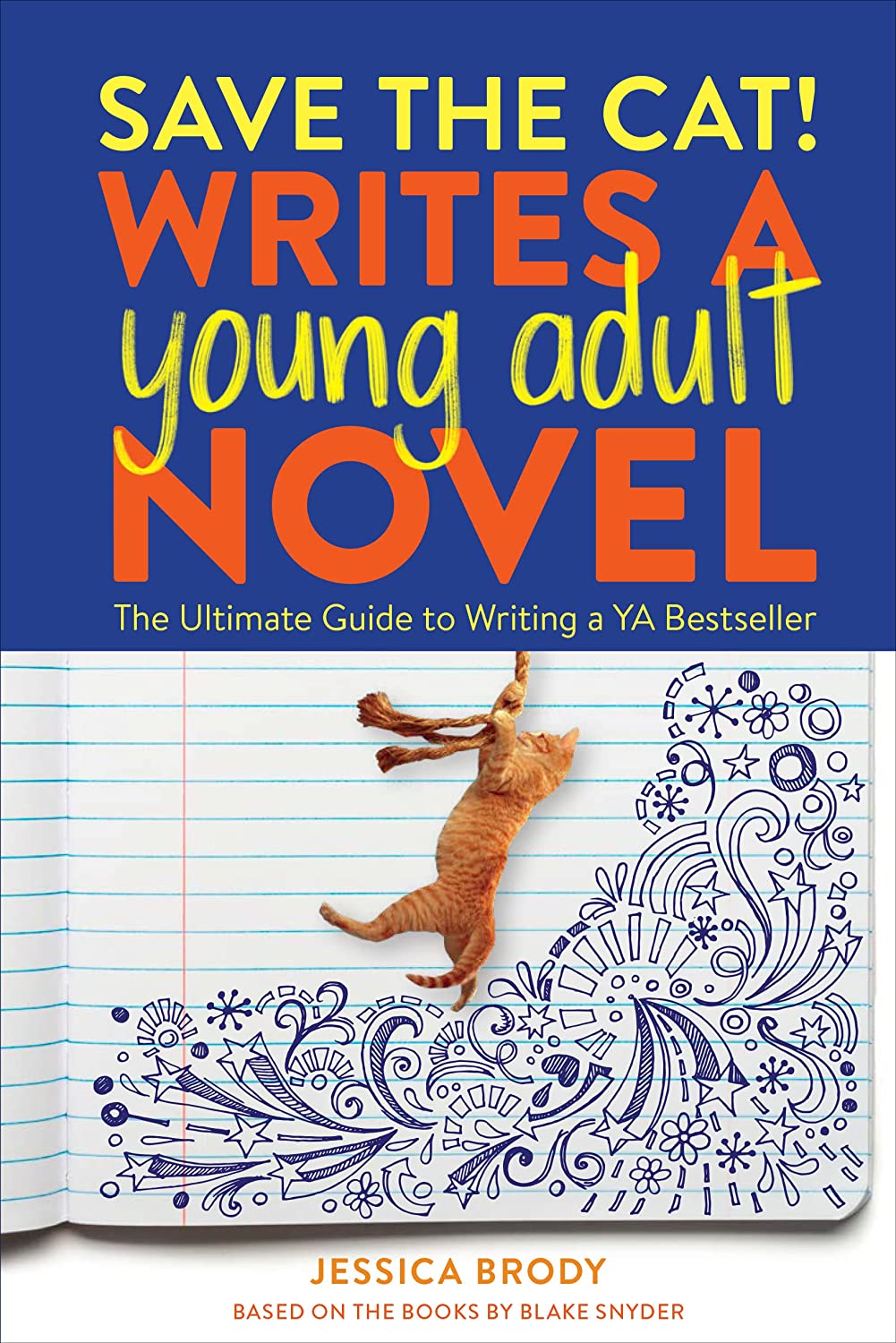
Save the Cat! Writes a Young Adult Novel expands on Blake Snyder’s screenwriting guide (Save the Cat!) and tweaks it to make it more easily applicable to YA novels. Along with the expected beat sheets, the author also includes guides to what she calls the ten Save the Cat! story genres. There’s also a chapter dedicated to writing a series and one about creating loglines and synopses when you’re preparing for publication/the agent hunt/whatever you decide to use them for.

The original Save the Cat! is pretty much the only craft book that I remember with fondness. Most I’m either meh about or hate with a passion. This particular craft book is better than most of the ones I’ve read, but I couldn’t get into it when the genres came up (and they’re most of the book). First, the good. I liked the beat sheet. It explains where events usually go and how plotlines merge and diverge and how to make your own beat sheet either before writing, during it, or between drafts. Plus, you can tweak it as needed if your story feels off. It’s a great tool. I also liked that the author discusses how to apply everything to a series and a synopsis. That was all actually very helpful.
My biggest problem with this book was the breakdown of genres. Instead of using traditional genres (fantasy, sci-fi, etc.), the author tries to categorize stories by their essence (rites of passage, buddy love, etc.). That’s cool. I like the idea. But there’s far too much overlap for these genres to be distinct from each other. How do I know? Because a lot of the same books are used as examples in multiple genres. It’s confusing. The author says that’s okay and that many people will disagree as to what books go into which genre, like it’s not a big deal. It’s fine for debates. But she also says each genre needs to include certain things. If my book crosses multiple genres, how do I know what to include? It’s confusing. Especially for newbie writers who might think a craft book is writing law and don’t realize they can break the rules. It’s just too messy for my liking.

The other problem I have with the book is definitely a me thing. I don’t like it when writers use their own work as examples in craft books. It just feels like they’re trying to get me to buy their stuff and they never delve as deeply into their own stuff, like they don’t want to give away spoilers. Meanwhile, they’ve just spoiled every other book they used as examples. This author does it sparingly until the chapter on series which is all about one of her series in the example. It’s annoying to me, but I know most readers don’t care.

As far as the writing goes, it’s a craft book. Starts out a little preachy, but that fades away pretty quickly. Otherwise, it’s long and very repetitive as most craft books are.

Ultimately, I found some useful things in Save the Cat! Writes a Young Adult Novel. It was one of the better craft books I’ve read. Apparently there’s also one about writing novels in general, so I might look that one up.

starstarstarstar outlinestar outline

Overall, I gave it 3 out of 5 stars. Craft books are either pretty good (4), meh(2), or bad (0) to me. This one leaned toward pretty good. If you’re writing a YA novel and you’re stuck, it’s worth having around.

Blog Tour/Review for ORDINARY GIRLS by Jaquira Diaz

Hello, hello! This week, I’m participating in the blog tour for the paperback release of Jaquira Diaz’s memoir Ordinary Girls. It was originally released in October, 2019 from Algonquin Books. Since then, it has received an abundance of praise and has won the Whiting Award in Nonfiction. Thanks to receiving a copy of the book from Algonquin Books and NetGalley, I’ll be providing my own review shortly, but first I thought I would share some praise the book’s already earned.

Diaz_OrdinaryGirls_440x125

“A skilled writer, Díaz is meticulous in her craft, and on page after page her writing truly sings. Her temporal leaps and switches in tense and point of view make the overall delivery both powerful and complex…  This brutally honest coming-of-age story is a painful yet illuminating memoir, a testament to resilience in the face of scarcity, a broken family, substance abuse, sexual assault, mental illness, suicide and violence.”
-The New York Times Book Review

“A fierce, unflinching account of ordinary girls leading extraordinary lives.”
-Poets & Writers

“Jaquira Díaz writes about ordinary girls living extraordinary lives. And Díaz is no ordinary observer. She is a wondrous survivor, a woman who has claimed her own voice, a writer who writes for those who have no voice, for the black and brown girls “who never saw themselves in books.” Jaquira Díaz writes about them with love. How extraordinary is that!”   
-Sandra Cisneros, author of The House on Mango Street

Díaz_OrdinaryGirls_pbk_HR_rgb
A gorgeous cover.

Ordinary Girls tells the story of Diaz’s life from a young childhood in Puerto Rico to an adolescence in Miami to an adulthood still searching for where she belongs. There are dysfunctional families that fall apart, friendships that transform into makeshift families, struggles being overcome, and so much more. It’s Diaz’s story, her life, but it’s also a relatable story for so many young women.

Diaz doesn’t shy away from the difficult topics. She writes openly about suicide and addiction from both sides. She writes about violence and racism and sexual assault. There’s a struggle with her own sexuality. There’s the growth from a teenage “delinquent” (just a girl who doesn’t know any other way to cope with life) to a young woman who knows she can be better and does the only thing she can think of to prove it to herself by joining the navy. And throughout the memoir, Diaz sprinkles in bits of Puerto Rican history to help define where she comes from. It makes for an interesting and moving combination.

The writing is strong. I admit that some of the shifts in tense and changes from more personal writing styles to more journalistic styles were jarring for me. I don’t read much nonfiction, so I’m used to a more uniform style. But once I stopped reading each section as a type of chapter and started reading them more as linked essays, I got into the flow of the book much easier.

Ultimately, Ordinary Girls was an intriguing and emotional piece that I’m glad I read. It’s not something I would have picked up on my own, but it’s relatable and for the parts I couldn’t relate to, it’s enlightening.

starstarstarstarstar outline

Overall, I gave it four out of five stars. If you enjoy memoirs, this is definitely one worth picking up.


Jaquira Díaz (c) Maria Esquinca_CMYK
Photo: Maria Esquinca

Jaquira Díaz was born in Puerto Rico and raised in Miami. She is the author of Ordinary Girls: A Memoir, winner of a Whiting Award, a Florida Book Awards Gold Medal, and a Lambda Literary Awards finalist. Ordinary Girls was a Summer/Fall 2019 Indies Introduce Selection, a Fall 2019 Barnes & Noble Discover Great New Writers Notable Selection, a November 2019 Indie Next Pick, and a Library Reads October pick. Díaz’s work has been published in The GuardianThe FaderConde Nast Traveler, T: The New York Times Style Magazine, and The Best American Essays 2016, among other publications. She is the recipient of two Pushcart Prizes, an Elizabeth George Foundation grant, and fellowships from the MacDowell Colony, the Kenyon Review, and the Wisconsin Institute for Creative Writing. A former Visiting Assistant Professor at the University of Wisconsin-Madison’s MFA Program in Creative Writing, and Consulting Editor at the Kenyon Review, she splits her time between Montréal and Miami Beach, with her partner, the writer Lars Horn. Her second book, I Am Deliberate: A Novel, is forthcoming from Algonquin Books.