Thoughts on TRAIL OF LIGHTNING

Howdy, howdy!  It’s the last Wednesday of September, which means it’s time for another book review.  I failed to get approval from NetGalley for a book this month (it happens, no biggie).  So, I decided to use one of the books we are supposed to be reading in the book club I’m in.  Trail of Lightning is the first book in Rebecca Roanhorse’s The Sixth World series.  It was released in June of 2018 by Saga Press.  Without further ado, let’s get to the review!

trail-of-lightning-9781534413498_hr
Pretty standard cover for the genre, but still neat.

Trail of Lightning follows Maggie Hoskie, a monster slayer, on her adventures through post-apocalyptic Dinétah (or what was the Navajo reservation).  She fights a new kind of monster, visits old allies, gets a new partner (Kai Arviso) thrust upon her despite her skepticism, deals with old foes, and has to face down her past in order to solve all the mysterious problems that keep cropping up.  All the while, she’s being jerked around by various gods.  Sounds cool, right?  It really is.

First, I have to admit that I had some trouble getting into the voice of the book.  It’s in first person, present tense.  That has never been my favorite POV, though I can’t really explain why.  I just have difficulties getting into it.  But once I got into the story, I didn’t mind it so much.  Maggie’s a fairly reliable narrator, except when it comes to Neizghání.  He’s a much bigger douchenozzle than she makes him out to be.  Even when people and other gods try to tell her how bad he was/is to her, she basically idolizes him because he took her in and trained her.  I wasn’t sure who to believe, then he shows up.  Yeah.  He’s not a great guy.  It was disconcerting at first, but then I remembered it’s in first person, so her view of everything doesn’t have to be accurate, it just has to be hers.

mvg87a.gif
The proper reaction when Neizghání shows up and you believed Maggie’s version of him.

As far as the plot goes, I really enjoyed it.  My knowledge of Navajo mythology is sorely lacking, but apparently I know more than I realized.  A basic grasp of some of the main players in Navajo myth is super helpful, but not necessary to enjoy the book.  Roanhorse does a wonderful job of explaining things without it feeling infodumpy.  She also focuses more on the growth of Maggie and Kai as people than the mythology, which makes for an engaging read.  The gods and monsters are there, but the focus is the characters.  That’s not to say the gods and monsters aren’t kickass.  They are.  I’m partial to Coyote despite everything.

source
Me when I finished the book.

About the only real complaint I had was that Kai’s second power was so obvious.  I know nothing about the clan stuff and how it works or what all the clans are, but I had his power pegged from the beginning.  And since it’s first person, all the information I had was the same information Maggie had.  He never told her to ignore the clues.  There was no reason for her not to notice it.  It made her seem willfully dense.  Maybe I missed something.  Maybe there was a reason she couldn’t put two and two together.  Maybe she just didn’t want to acknowledge it.  But it wasn’t a big revelation for me, so the climax lost some of its power.

Ultimately, I was really happy with the book.  It left me at a point where I wanted more, so I’d say that’s what really counts.  I’m just a little ticked off that I have to wait until April for the next one, but that’s what I get for starting a series when it first comes out.

starstarstarstarstar outline

Overall, I gave it four out of five stars.  My problems with it weren’t major and I loved the characters enough to want more.  If you’re into monster hunting and post-apocalyptic fun, definitely give it a shot.  Even if you’re not, try it anyway.
Finding Your Genre

Hello, hello!  When submitting to agents, one of the most common questions a writer has to answer is what genre they write.  Sometimes, this is a really difficult thing to explain, especially if you’re not quite sure yourself.  Granted, I know some writers who can tell you what they write down to the subgenre’s subgenre.  But, I’m not one of them.  And honestly, they kind of freak me out (but I still love them).  I never really understood how people could stick to such narrow categories in order to be a specific type of writer.  It always seemed constrictive to me.  But I eventually fell into a genre and it felt good to know where I belonged, even if I do have a tendency to wander away from it.  So, I thought I’d share how I found my genre.

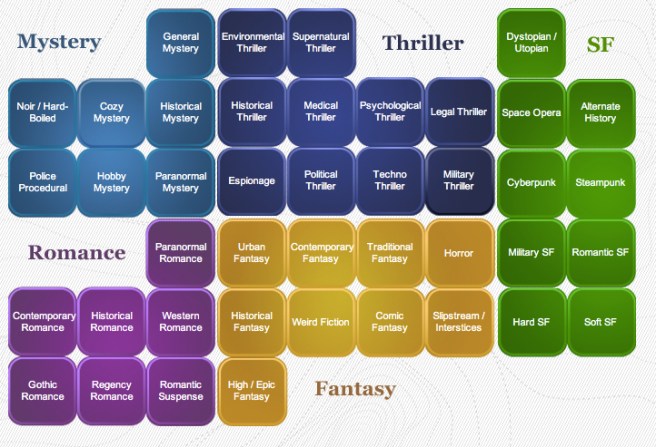
genre-map
A genre map… and this is just the basics, not including YA and the like.

When I first got into Stonecoast, I had people asking me what I wrote and my go-to response was horror.  At the time, it’s what most of my writing vaguely (and not so vaguely) fell under.  But the truth was, I was still searching for what I was most comfortable writing.  I liked dabbling in all kinds of genres, and still do.  It was always fun for me when I stepped outside of my comfort zone, so I never really felt right restricting myself with genre labels.  Don’t get me wrong, horror was and will always be my true love, but it’s not an entirely accurate description of my writing.

It wasn’t until my fourth semester, during my first half workshop with Nancy Holder (who had also been my mentor my first semester), that I started narrowing in on what genre I felt most comfortable in.  When I was on the chopping block, Nancy said my story was “vintage Shawna.”  She went on to explain that in her time working with me, she noticed that I tended to write about younger (usually teenaged) protagonists who stumbled upon hidden worlds.  She wasn’t wrong.  Apparently, I had fallen into the YA (young adult) realm when I wasn’t looking.

sub-buzz-29538-1490304640-6
I admit this is totally what I thought of when I was accused of writing YA.

It wasn’t exactly my genre of choice, but YA chose me, so I couldn’t argue with it.  Granted, I’ve managed to keep my horror leanings even in most of my YA work.  Demons and psychological torture and all of that still play big roles in my writing, but there’s also a stronger thread of good old-fashioned fantasy as well.  Now, I mostly tell people that I write supernatural YA (not to be confused with paranormal romance) or just YA fantasy.  It’s closer to the truth for the majority of my work.  Though, I do have pieces that don’t fall anywhere near those genres, because writing is hard enough without restricting yourself to one genre.

Writingishard
It really is sometimes.

So, I found my genre when I wasn’t even looking.  Actually, I guess it found me.  But I will always suggest stepping outside your genre, whether when reading or writing or both.  It’s fun and challenging and you can learn a lot when you’re working outside your comfort zone.

What about you?  Have you found your genre yet?  If so, how?  Do you like working within super specific boxes or do enjoy the freedom of vagueness and blurred lines?  Share your thoughts and comments here or on my social media pages!