Thoughts on SNOW WHITE LEARNS WITCHCRAFT

Howdy, howdy!  It’s the last Wednesday of the month, which means it’s book review time!  Didn’t I just do this?  Seems like it, but that was just to make up for January.  February gets its own book.  This month, I’m going to talk about Snow White Learns Witchcraft, which is a collection of short stories and poems by Theodora Goss.  Technically, I received access to an advanced reader copy (ARC) through NetGalley, but they archived it without warning a few days after the approval and I hadn’t downloaded it yet.  Sadness.  Then, I realized it was releasing on February 5th, so I would have plenty of time to buy a copy and read it in time to review it.  Happiness!  Anyway, let’s get to it.

71+-WqwvtqL
A lovely cover.

Snow White Learns Witchcraft is a little misleading as a title for the entire collection because Snow White isn’t the only fairy tale revisited among these pieces.  Goss adds her own personal touch as she retells many beloved tales from Goldilocks to the Little Mermaid to Cinderella to some that I’m not even familiar with.  A mixture of poetry and short stories, this collection is sure to have something for all fairy tale lovers to get lost in.

I think I’ll start with the short stories.  My personal favorite was “Conversations with the Sea Witch,” but I admit that I’m biased because the Little Mermaid happens to be my favorite fairy tale.  It tells the story of an old crippled woman who has lived her happy life with her prince and is now awaiting death.  Each day her servants wheel her out on the balcony for fresh air and she has conversations with her friend, the sea witch who gave her legs.  We get to hear about the witch and how she ended up the way she is.  It’s a neat, quick story.  Most of the stories in this collection come at their mother fairy tales from new and interesting directions.  Some are set in olden times while others are in the present and many are somewhere between the two.  Many of the tales are quick reads, but some drag a little.  I think that’s why “A Country Called Winter” wasn’t as enjoyable as others for me; it felt slow.  It was one of the tales I wasn’t familiar with, but it was predictable enough that I wasn’t pulled along the way I would have been if I didn’t know what was going to happen.  Don’t get me wrong, I liked this story (and all the others), it simply wasn’t my favorite.
Ve5w
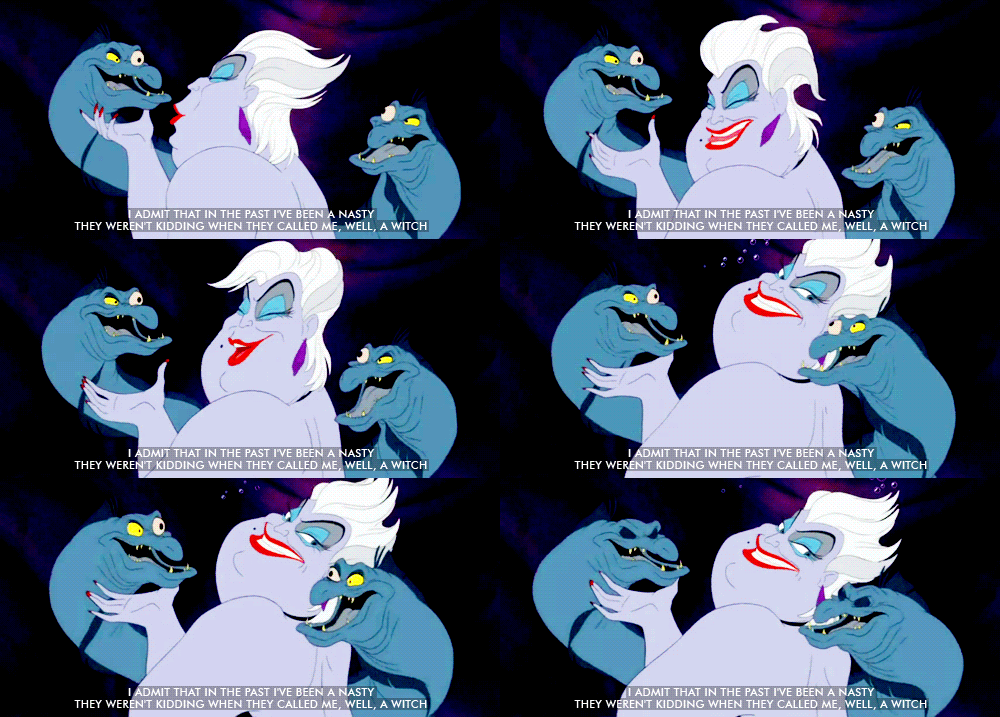
She does get nasty.

The poetry in this collection was wonderful.  “The Ogress Queen” delights the senses as she ponders what delicacies Helios, Aurora, and their mother would taste like.  “Diamonds and Toads” offers up an amusing situation that leaves the reader with a number of potential lessons it could be trying to teach.  I’d like to believe it’s showing us that every bad situation has a potential upside if you’re willing to look for it.  Like all fairy tales, each poem leaves us with a lesson.  Some of these, the speaker comes right out and says, others we have to dig for.

alright-then-lessons-learned

The writing in this collection is as varied as the stories and poems.  Goss captures each voice like she’s the sea witch.  As I said earlier, the pace changes from piece to piece, but all in all this was a fast and fun read.

Ultimately, I’m happy that I went ahead and bought Snow White Learns Witchcraft.  Fairy tales are some of my favorite reading material.  This book was worth adding to my collection.

starstarstarstarstar outline

Overall, I gave this collection 4 out of 5 stars.  I wavered between four and five because I always expect to not enjoy some pieces as much as others when reading a collection like this, so I shouldn’t let that affect my decision, right?  But I settled on four because it seemed fair and true to how I felt about everything.  If you like fairy tales, check this book out!

Thoughts on DEAD AS A DOOR KNOCKER

Howdy, howdy!  Since I missed last month’s book review, I figured I would go ahead and do it this week.  After all, I’m only a week late.  That’s not too bad, right?  For January, I picked up an advanced reader copy (ARC) of the first book in a new cozy mystery series.  Dead as a Door Knocker is the the first book in Diane Kelly’s House Flipper Mysteries.  As usual, I must thank NetGalley and the publisher, St. Martin’s Press, for granting me access to this book in exchange for an honest and unbiased review.  Now, we might as well get to the review!

51pGIJmP1pL
Cover is relevant to the book, but the knocker is all wrong.  It’s supposed to be the Green Man.

Dead as a Door Knocker introduces us to Whitney Whitaker, a 28-year-old who enjoys helping her cousins remodel houses and harbors dreams of becoming a real estate guru.  She lives with her parents and her cat, Sawdust, in Nashville and works at a small mom-and-pop property management firm.  When the firm’s biggest client offers her a deal on a property that’s too good to be true, she jumps on it.  However, the guy is murdered on the site and everything goes haywire from there.

I’m just going to come out and say it: I didn’t like this book.  The story was the same as every other cozy, which could have been fine.  Combine it with the fact that the main character is extremely unlikable and not even the parts from the cat’s point of view could save it.  Why is Whitney unlikable?  First off, she’s 28 and acts like she’s 15.  If she doesn’t get her way, she pouts or throws a fit.  Second, she’s a bully.  She runs around questioning people like she’s a cop or something, ambushing people and even forcing her foot in doorways so people can’t close the door, then has the gall the get upset when she gets a glass of iced tea thrown in her face.  I had zero respect for her.

giphy (12)
My thoughts exactly.

The background characters were flat and only served to enable Whitney’s antics.  She dragged her cousin and her best friend around as bodyguards, neither of whom ever bothered pointing out when she was crossing boundaries.  The detective let her go based on weak arguments and tantrums.  I get that it’s a story and all, but it still needs to be believable.  None of these characters came across as actual people, especially the police.

tibs.gif
Basically.

As far as the writing goes, it was a tight, quick read.  Every other sentence seemed like a well-worn cliché or at least a play on one.  If the author was aiming to make Whitney sound like a 15-year-old, she was spot on.  But don’t go into it hoping for the 28-year-old we’re supposed to be getting.

Ultimately, I was super disappointed in this story.  I just couldn’t get past the characters.  It’s not a series I’ll be following.

starstar outlinestar outlinestar outlinestar outline

Overall, I gave Dead as a Door Knocker one star out of five.  Pretty sure this is a first for me.  I honestly feel bad.  I really wanted to like it, but nope.  If you’re okay with childish characters and unrealistic police officers, try it.  Otherwise, you’re not missing anything.

Thoughts On KUSHIEL’S DART

Hello, hello!  Welcome to August.  Where has the year gone?  Recently, I’ve been trying to read Kushiel’s Dart by Jacqueline Carey, which was on my short summer reading list.  While it’s a relatively long book (900ish pages), the fact that I’m still stuck around page 100 doesn’t bode well for me finishing it.  In fact, I can pretty much guarantee that I won’t be reading the rest of it.  I feel bad, because a good friend recommended the book, but I just can’t get into it.  So, I thought I would give my thoughts on it thus far before I stash it away, deep in my bookcase, and grab something else to read.

81qfrKAYBaL
“Sophisticated” = too mature for me, I guess.

First, I want to say that I had high hopes for this novel.  The plot sounds really interesting and the way the main character, Phedre, was described to me made her sound amazing.  I’m sure when she grows up (she’s currently 16 where I stopped), she’ll be a badass.  But there’re a lot of things that I just can’t get past about this world.

For starters, the Court of Night Blooming Flowers.  It’s basically a bunch of high-end brothels, which I am totally fine with and was intrigued by.  At least until it started getting into the details where the children that the houses take in, either because the parents can’t care for them or they’re born into the house, are coerced (they make it sound like it’s a choice, but the kids are groomed for it from day one) into learning the “ways of Naamah” (sex) when they hit the age of 14 in order to pay back the debt they incurred by being raised in the specific houses.  Granted, Phedre escapes this by being purchased by someone who puts off her actual training until she’s older (she’s 16 and still a virgin when I stopped reading).  If it were a normal bodily exploration thing, I wouldn’t think twice about it, but these are kids being used to make money. I can’t get over the icky feeling I get from it, even though I understand that this is the norm in that world.

wtf042.gif
This is me trying to read this book.

There’s also the background story about how an angel, Elua, decided to go on a walkabout to find people who would accept him and was followed around by some companions because even other angels worshipped him.  While on this walkabout, Naamah prostitutes herself to get the stuff Elua needs (from his freedom when he’s imprisoned to his food).  Because that’s what women do, apparently: they sell themselves to take care of a perfectly able man.  Thus, prostitution became a holy act and that’s why the Night Court exists.  Which is actually a pretty cool story (except the whole doing it for a guy part).  And no one is supposed to be forced into prostitution lest it sully the act.  But, like I said, when a kid is groomed for it their entire life, it certainly feels like coercion to me.

Despite all of that, I would probably keep reading for the main storyline, but the writing style is what’s really stopping me.  There’s a lot of flowery, purple prose.  It seems like every sentence contains at least one adverb.  Most of the time, I feel like the author is just trying to show off how big her vocabulary is.  And that’s a huge turn off for me.

futurama-fry-so-many-words-eyes-glazing-over
It’s true.

I apologize to my friend and anyone else who loves this book, but it’s not for me.  Maybe it gets better.  Perhaps in a few years, I’ll be mature enough to appreciate it for the “sophisticated fantasy” it’s claimed to be.  But for now, I’m putting it away and turning my attention elsewhere.

Thoughts on Gaiman’s Norse Mythology

Howdy, howdy!  I recently finished reading Norse Mythology by Neil Gaiman and thought I would share some of my feelings about it.  Let me start by explaining that it’s the first book I’ve really sat down and read in a long time.  I’ve started others, but nothing has held my attention beyond the first few pages lately (not that they were bad, I just haven’t been in a mood that’s good for reading).  So, I thought maybe a book of short stories by one of my favorite authors would get me back into a reading rhythm.  It worked and here we are.

7828138-0-norsemythology-3D
You have to admit it’s a pretty book.

If I’m being honest, I can’t think of a single Neil Gaiman book I’ve read that I don’t have mixed feelings about.  Norse Mythology is no exception.  Yet his stories hold a special place in my heart despite everything I question (or even hate) about them.  Why?  Usually because there’s something memorable about the worlds or because I can relate to the characters.  Not to mention that I simply enjoy his writing style, which is clear and simple and easy to get lost in.

But Norse Mythology is different, because this isn’t one of Gaiman’s worlds and these aren’t his characters.  These stories have been around for centuries.  This collection is just those stories written with his voice.   These are the tales of the gods of Asgard.  We start with a brief introduction to the main players, then get into the creation myth and work our way through a number of notable moments until we get all the way to Ragnarok.  These are tales many of us have heard before in one form or another.  It makes it really difficult for me to figure out if I liked the stories because I’m familiar with a lot of them already or because of the way Gaiman tells them.  I like to think it’s a little bit of both.

Thor_Odin_Loki
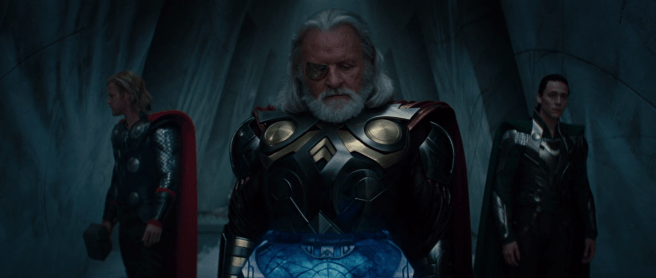
If you read it, don’t go into these stories expecting the Marvel version.

As I mentioned, though, I had some mixed feelings about Norse Mythology.  While I loved the stories, I kept running across moments that I wanted to see better, rather than just being told about.  Don’t get me wrong, I know that this collection was written more in the vein of oral storytelling, which is vastly different from the written story in that it needs to be quick and easy to understand and entertaining, whereas you could spend ten pages of a written story describing a flower (you shouldn’t, but you could).  I get that, but one of the golden rules of writing is to show, not tell.  It’s really hard for me to ignore that rule.  There were just a few parts that I thought would’ve benefited from a little more action.

the_children_of_loki_by_jap_jap-d4cemo4
Because Loki’s kids were awesome and got the short end of the stick.

Ultimately, I enjoyed Norse Mythology.  It’s definitely a book I would recommend to people, especially if they’re new to the mythology and want to get a quick, but fairly in depth introduction to it.  What about you?  If you’ve read the collection, feel free to share your thoughts here or on my social media pages!