Avoiding Becoming The Token Cripple

Howdy, howdy!  I hope everyone is having a wonderful week.  Today, I want to talk a little about some of my struggles with deciding how much to reveal about myself when submitting to publishers and/or agents.  I know it doesn’t seem like a big deal in the grand scheme of things, especially with Garnets and Guardians, because being cripple is the best asset one can have when writing cripple characters, right?  But, honestly, it’s really difficult to know how much to reveal about yourself and how that information is going to influence the people who are ultimately judging your talent (or lack thereof).
6M3X1
There’s a thin line that I don’t want to cross.

When it comes to submitting short stories to various magazines, I don’t bother mentioning my disability.  Mostly, I keep it to myself because it has no bearing on the stories I submit.  There aren’t any cripple characters in my short stories, so there’s no point in mentioning it.  But, I also keep it to myself because I fear the concept of a pity pub (getting published because they feel sorry for me).  I understand that these are professionals who are supposed to be above such actions, but years of “cripple perks” (earning awards in high school for simply doing the work I was assigned, being called “inspirational” at college just because I preferred classes on campus instead of online, etc.) have made me wary of succeeding in subjective areas.  It’s just something I will always be worried about.

However, when I began submitting Garnets and Guardians to agents, I was forced to reevaluate the choice to keep my disability out of things.  On the one hand, I don’t want to take the chance of people judging my writing less harshly just because I’m cripple.  I also don’t want agents to become intrigued by me even if they aren’t enthusiastic about my writing.  I’m not interested in being anyone’s token cripple.  On the other hand, the protagonist of my novel has a disability, so my own crippleness gives me a unique perspective into her development as a realistic character.
b927f1a31fcbaa6421272bbde12cc70e
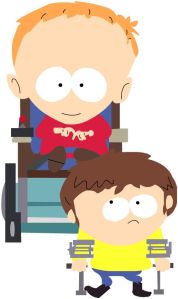
We can’t all write Timmy and Jimmy.

In the end, I chose simply to mention my disability in passing in my query letter.  I don’t know if it’s the correct decision or not.  Sometimes, I wonder if I should go into more detail, but then I worry it will seem like I’m hoping for special treatment, which I also want to avoid.  I was raised to never expect or ask for special treatment beyond the accommodations I need (but not to turn it down in certain cases either).  But ultimately, a brief mention of it to establish that I have knowledge about cripple experiences feels necessary.  Besides, if my query letter intrigues an agent and they decide to look at my website or blog, they’re going to find out about my crippleness anyway, so it’s not as if I’m hiding it.
mermaid
I try, but how much of myself should I be?

So yeah, while I don’t technically hide my disability from people, I remain wary about announcing it in a professional (virtually anonymous) setting just in case it will cause people to think differently about me.  What about you?  Is there anything you refrain from mentioning because of similar reasons?  What about completely different reasons?  Feel free to share here or on my social media sites!

Until next time!
Writing Cripple Characters

Hello, hello!  I hope all of my US and Canadian friends had wonderful independence days!  Mine was quiet.  It was spent writing this and playing mindless games, because I was a little tired and didn’t feel like doing anything else.  But that’s not what I’m here to talk about today.  I wanted to tell you all a bit about the protagonist of my current series-in-progress and why I chose to make her cripple (this is my preferred term, so if it offends you… sorry, not sorry).

54eb8caa17368_-_fourth-of-july-cupcakes-lgn-32120142
I wish I had cupcakes.

Garnets and Guardians is the first book in my Demonic Jewels (working title) series.  The series follows Bailey Donovan, a thirteen-year-old who has recently been diagnosed with Limb-Girdle disease, as she struggles to cope not only with her illness, but also with moving to a new town and the dark discovery she makes there.  Despite everything, she remains fairly stoic, which occasionally causes drama within her family.  And yes, unlike many protagonists in the fantasy genre, Bailey’s family remains whole and supportive.

So, why did I choose to write about a young girl who is newly cripple?  I’ve actually heard a lot of theories on this in various workshops.  The one I get the most is that I’m writing what I know, or that Bailey’s a fantasy version of me, or similarly weird things.  In a lot of ways, she is like me.  She doesn’t do well with emotional displays and she likes to handle things her own way.  But her disability is nothing like mine, so she has to cope differently, which really means she’s a completely separate person from me.  There’s also the theory that I write cripple characters because they are few and far between in genre fiction and I want to see myself reflected in these genres I love.  I’ve covered that before: yes, diversity is important, but I (personally) don’t need or want characters to be cripple in order for me to identify with them.

criplit-and-dislit
Apparently, this is a thing?  Interesting.  Chose to share because of number 3.

All of that is great and I’m sure it’s why some people choose to write cripple characters, but it’s not why I did.  Honestly, I just wanted to write about a hospital full of demons.  What better way to do that than to give my protagonist a chronic disease that forces interaction with such a place?  Yeah, I chose a disease within my realm of understanding, but that’s only because I hate doing immense amounts of research.  So, for me, writing a cripple character has less to do with crippleness itself and much more to do with what fits the story and me being too lazy to look stuff up.

1331923161599_760411
Writing is hard enough without the research.

Have you ever written a cripple character?  Did you do so for the sake of diversity or was it just something you wanted to try out?  Have you wanted to write a cripple character but chose not to?  Why?  No judgment here, so feel free to share your thoughts and stories and reasons below or on my social media pages!

On Labels as Identities

Hello, hello!  I’m back and (mostly) better.  Lately, my posts have been relatively light and fluffy, but today I want to ramble a little about another touchy subject: labels as identities.  What I mean by “labels as identities” is all of those terms we use to answer that infuriatingly unanswerable question, “who are you?”  Well, I’m Shawna!  But, who is Shawna? … How the hell am I supposed to know?

l-88537A couple of weeks ago, a friend of mine posted an article on Facebook about how the labels “heterosexual” and “homosexual” are more detrimental than not, which got me to thinking.  I don’t know if I actually agreed with much of the article, but I certainly do think that the plethora of labels people feel the need to use to identify themselves is becoming harmful.  Rather than bringing us closer together, these labels are causing further divides.  I suppose I should probably explain some of my thought process and hope it makes things clearer.

First, let me say that in my reasoning, it’s important to remember that these labels or identities or whatever you want to call them ultimately define only what we are, not who we are.  For example, I tend to use the term “cripple” as one of my labels.  It’s what I am, but it’s not who I am.  Who I am as a person has more to do with my preference towards “cripple” instead of the PC term of the week (I think it’s “differently abled” at the moment or something like that), than me being crippled has to do with who I am.  It’s simply my adjective of choice.  One of so many adjectives that it’s getting really hard to keep everything straight.

IujJrBm

The who is so much more than anything a label can define.  It’s something unexplainable. Humans have this insatiable desire to give everything a name or some form of identification.  We can’t be satisfied with general terminology, we have to be exact.  You don’t believe me?  Just think of the color red.  How many different words can you think of that describe a shade of red?  Scarlet, crimson, rose, blood, ruby, garnet, vermillion… the list goes on.  Now, apply that to people.  Think of the currently expanding list of gender and sexual identities, not to mention all of the random adjectives we apply to all of the other aspects of ourselves.  We use these labels and identities to try to explain something that is indescribable. And normally, that’s fine. But in today’s society, we’ve become so obsessed with telling people what we are that we forget to show them who we are.  And I think that’s really sad.

crisi-contenuti
Labels, like beauty, are relative.

In other words, I guess what I’m trying to say is that we need to stop worrying about who’s black or white or Christian or Muslim or liberal or conservative or any of that, and start focusing on who people really are.  Start worrying about whether people are asshats (another label, I know, but you get the point) or not.  If they are, none of the rest of that stuff will redeem them, and if they aren’t, well nothing else really matters.  Be who you are and don’t worry about what some label says you have to be.  That’s all.