Shaking Off The Rust

Howdy, howdy!  Yesterday was Dad’s birthday, so I want to say another quick happy (belated) birthday to him!  Feel free to leave him a greeting here or on my social media pages and I’ll pass it on to him.  Anyway, this week, I want to ramble a bit about figuring out when to switch projects and when to power through the slow points, which is something I really struggle with.  I was always encouraged to finish a project before moving on to the next one.  But what happens when you try to push through the mental wall blocking you from the story and three months later you’ve only managed to move forward thirty pages?  When is enough enough?

tumblr_ob5dn9Eqpf1svs9vho1_500
It’s kind of like when your EVA goes berserk and tries to smash through the wall, but there’s just more wall behind that wall, until it finally it runs out of energy and you, the pilot, are left a bleeding and broken mess.  Yeah, like that.

Lately, I’ve been feeling a little (okay, extremely) stagnant when it comes to my writing.  I fully admit that I haven’t been working on that front as much as I should, even though I have no excuse not to be writing.  But the words refuse to come.  I know the storyline and everything, but the novel doesn’t excite me at the moment.  In fact, it doesn’t instill any emotions in me.  That’s not to say that I’ve given up on it.  Not at all.  I know exactly why I’m lacking any emotional investment in this book (it’s the second book in my Demonic Jewels series, the first of which I’m querying agents with and I can only take so many rejections before I start questioning the entire concept of the series, but that feeling will eventually pass, I hope).  And I’ve been trying to push through all of this for the better part of three months, but it’s proving impossible.

I’ve tried a number of tactics to get past the wall.  I wrote some short stories then tried to go back to the novel.  Didn’t help.  I worked on revisions to a different novel then tried once again to get back to Bailey and her crew.  No luck.  I even tried just plotting everything out in my head so I’d know exactly where I was going when I sat down to write (a method that has worked well in the past), and still nothing.  What else can I do?  Seriously, I’m open to suggestions.

11376642_1567759673485171_1727505224_n
I don’t think dropping an anvil on me will work, but you can try!

However, over the past two weeks, some characters who have lived in my head for many years (at least 12) have been pushing their way to the front of my mind.  Normally, they only bring vague story ideas with them, but this time they have something concrete that I’m actually super in love with.  It’s well outside of my wheelhouse, combining fantasy (I can do that) with a cozy-esque mystery (not so sure I can pull that part off) and a dash of romance (will probably fail miserably at that part).  But I’m excited just thinking about it, and the last thing I felt this way about I finished in record time.  So, I’ve decided to put Bailey on the back burner again while I revise my other novel-in-progress and write this new one.  Is that a stupid decision?  Maybe.  But if it gets me writing, who cares?

wish+me+luckWhat about you?  What do you do when you can’t get past a block on a project?  How do you know when it’s time to set things aside and try something else?  Leave your thoughts or comments or questions here or on my social media pages!

Avoiding Becoming The Token Cripple

Howdy, howdy!  I hope everyone is having a wonderful week.  Today, I want to talk a little about some of my struggles with deciding how much to reveal about myself when submitting to publishers and/or agents.  I know it doesn’t seem like a big deal in the grand scheme of things, especially with Garnets and Guardians, because being cripple is the best asset one can have when writing cripple characters, right?  But, honestly, it’s really difficult to know how much to reveal about yourself and how that information is going to influence the people who are ultimately judging your talent (or lack thereof).

6M3X1
There’s a thin line that I don’t want to cross.

When it comes to submitting short stories to various magazines, I don’t bother mentioning my disability.  Mostly, I keep it to myself because it has no bearing on the stories I submit.  There aren’t any cripple characters in my short stories, so there’s no point in mentioning it.  But, I also keep it to myself because I fear the concept of a pity pub (getting published because they feel sorry for me).  I understand that these are professionals who are supposed to be above such actions, but years of “cripple perks” (earning awards in high school for simply doing the work I was assigned, being called “inspirational” at college just because I preferred classes on campus instead of online, etc.) have made me wary of succeeding in subjective areas.  It’s just something I will always be worried about.

However, when I began submitting Garnets and Guardians to agents, I was forced to reevaluate the choice to keep my disability out of things.  On the one hand, I don’t want to take the chance of people judging my writing less harshly just because I’m cripple.  I also don’t want agents to become intrigued by me even if they aren’t enthusiastic about my writing.  I’m not interested in being anyone’s token cripple.  On the other hand, the protagonist of my novel has a disability, so my own crippleness gives me a unique perspective into her development as a realistic character.

b927f1a31fcbaa6421272bbde12cc70e
We can’t all write Timmy and Jimmy.

In the end, I chose simply to mention my disability in passing in my query letter.  I don’t know if it’s the correct decision or not.  Sometimes, I wonder if I should go into more detail, but then I worry it will seem like I’m hoping for special treatment, which I also want to avoid.  I was raised to never expect or ask for special treatment beyond the accommodations I need (but not to turn it down in certain cases either).  But ultimately, a brief mention of it to establish that I have knowledge about cripple experiences feels necessary.  Besides, if my query letter intrigues an agent and they decide to look at my website or blog, they’re going to find out about my crippleness anyway, so it’s not as if I’m hiding it.

mermaid
I try, but how much of myself should I be?

So yeah, while I don’t technically hide my disability from people, I remain wary about announcing it in a professional (virtually anonymous) setting just in case it will cause people to think differently about me.  What about you?  Is there anything you refrain from mentioning because of similar reasons?  What about completely different reasons?  Feel free to share here or on my social media sites!

Until next time!

Writing Cripple Characters

Hello, hello!  I hope all of my US and Canadian friends had wonderful independence days!  Mine was quiet.  It was spent writing this and playing mindless games, because I was a little tired and didn’t feel like doing anything else.  But that’s not what I’m here to talk about today.  I wanted to tell you all a bit about the protagonist of my current series-in-progress and why I chose to make her cripple (this is my preferred term, so if it offends you… sorry, not sorry).

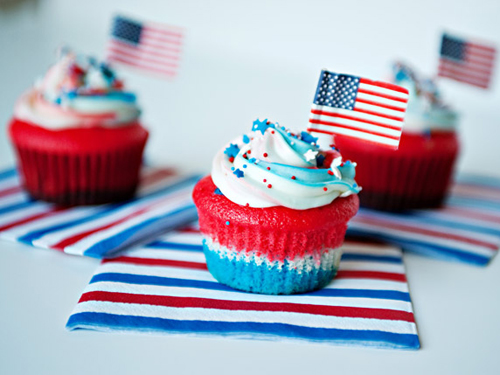
54eb8caa17368_-_fourth-of-july-cupcakes-lgn-32120142
I wish I had cupcakes.

Garnets and Guardians is the first book in my Demonic Jewels (working title) series.  The series follows Bailey Donovan, a thirteen-year-old who has recently been diagnosed with Limb-Girdle disease, as she struggles to cope not only with her illness, but also with moving to a new town and the dark discovery she makes there.  Despite everything, she remains fairly stoic, which occasionally causes drama within her family.  And yes, unlike many protagonists in the fantasy genre, Bailey’s family remains whole and supportive.

So, why did I choose to write about a young girl who is newly cripple?  I’ve actually heard a lot of theories on this in various workshops.  The one I get the most is that I’m writing what I know, or that Bailey’s a fantasy version of me, or similarly weird things.  In a lot of ways, she is like me.  She doesn’t do well with emotional displays and she likes to handle things her own way.  But her disability is nothing like mine, so she has to cope differently, which really means she’s a completely separate person from me.  There’s also the theory that I write cripple characters because they are few and far between in genre fiction and I want to see myself reflected in these genres I love.  I’ve covered that before: yes, diversity is important, but I (personally) don’t need or want characters to be cripple in order for me to identify with them.

criplit-and-dislit
Apparently, this is a thing?  Interesting.  Chose to share because of number 3.

All of that is great and I’m sure it’s why some people choose to write cripple characters, but it’s not why I did.  Honestly, I just wanted to write about a hospital full of demons.  What better way to do that than to give my protagonist a chronic disease that forces interaction with such a place?  Yeah, I chose a disease within my realm of understanding, but that’s only because I hate doing immense amounts of research.  So, for me, writing a cripple character has less to do with crippleness itself and much more to do with what fits the story and me being too lazy to look stuff up.

1331923161599_760411
Writing is hard enough without the research.

Have you ever written a cripple character?  Did you do so for the sake of diversity or was it just something you wanted to try out?  Have you wanted to write a cripple character but chose not to?  Why?  No judgment here, so feel free to share your thoughts and stories and reasons below or on my social media pages!

Author Spotlight: Danielle Rose

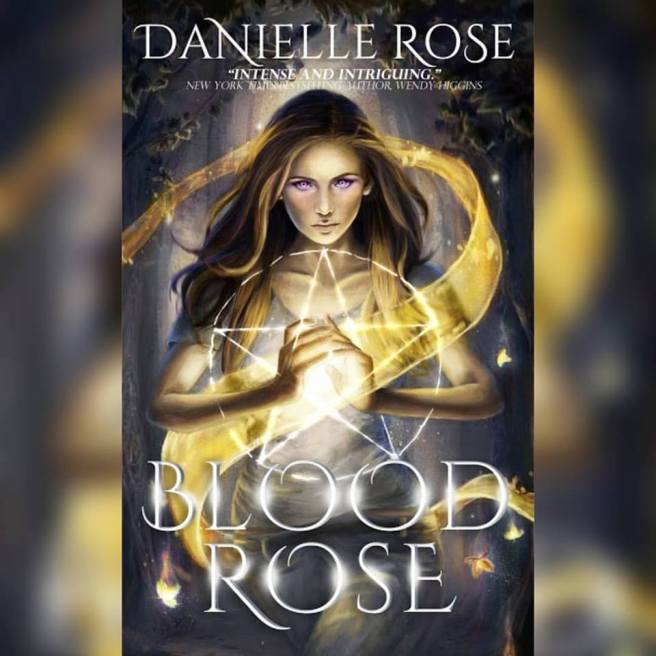
Howdy, howdy!  My friend, fellow Stonecoaster, and partner in writerly mischief, Danielle Rose, recently released the first of her Blood Books trilogy, Blood Rose, through Oftomes PublishingBlood Magic (book two) drops on August 1st as well.  So, I thought I would take a chance to do a little interview with Danielle.

Blood-Rose-Front-Cover
The cover of book one!

Q: Can you tell us a little about yourself for those who don’t know you?

A: I’m Danielle Rose, author of the Blood Books trilogy, which is being released back to back by OfTomes Publishing in 2017.  I’m also the owner of Narrative Ink Editing LLC, an independent editing company that assists in the preparation of independent authors’ manuscripts.  Sometimes, I teach composition at the university level.

Q: You seem to do so much: you own an editing business, you market your new releases, you’re writing a new book… how do you do it all?  Can you offer any tips and tricks?

A: It’s hard work, but I have a support team, including a personal assistant and PR goddess, as well as a writing group.  It’s important that I have someone there to hold me accountable.  Goal setting is a major aspect of my writing group, and that really helps me (and my horrible memory!) check-off things on my to-do list.

Q: What is your all-time favorite thing to write about?

A: The human condition.  It’s truly fascinates me.  In all of my books, I explore what it means to be human and the choices we make because we’re human.  I like to put my characters in some pretty tight situations and see what they would (realistically) do to get through these tough times.  I think my fascination stems from the digital era we live in.  With the click of a button, we have access to witness awful things, and we are quick to judge.  Sometimes, I wonder what we would truly do had we been in these positions.  I explore these themes in my writing.

Q: What’s the one genre you are dying to write?

A: Psychological thrillers.  I would love to write those!

Q: What is it like to begin your career as an indie author and then become traditionally published?

A: It’s been an interesting journey.  I’ve had to learn to sit back and let someone else take control, which is difficult for me to do.  I’m used to controlling every aspect of my career, from release date to cover design.  Thankfully, my publisher truly cares about my opinions, and he asks for my input on just about everything he does.

Q: Do you prefer self-publishing or traditional publishing?  Why?

A: Comparing self-publishing to traditional publishing is like comparing cats to dogs: there are similarities there, but in truth, they’re two different species.  In self-publishing, the writer experiences the entire weight of the publishing process.  A traditionally published writer has a support team.  Because I have the get-it-done mentality, it’s natural for me to take control, especially if it’s regarding my career.  Because of this, self-publishing works better for me.  However, I absolutely adore my publisher, and I can’t imagine releasing my Blood Books trilogy without them.  With that being said, I can’t say that I like one better than the other.  They’re two completely different experiences, and I wouldn’t be the writer I am today if I hadn’t gone through both methods.

Q: What is the single greatest piece of marketing advice you can offer emerging writers?

A: Offer advance reader copies (ARCs) of your books and require readers to post a review on release day.  This is such an important step to the launch of a book release, because it knocks out many birds with one stone:

1. Readers often flood social media with pictures and posts of their advance copy. (Everyone loves a bragger when it comes to the pre-release of a book!)

2. Readers post a review to platforms, which help to establish your book with new readers in an oversaturated market.

3. Many platforms, like Amazon, will help promote your book for free once you reach a certain number of reviews.

Q: Which writers do you fangirl over?

A: SO many!  I met Meredith Wild (Hacker) recently, and I could barely speak.  (Ha!)  I also love Richelle Mead (Vampire Academy), Chloe Neill (Chicagoland Vampires), and Lauren Blakely (anything, really).  Honestly, I’d fangirl over anyone who wrote a great romance novel.

Q: Join the debate: should emerging writers get a degree in writing before embarking on this journey?

A: Yes.  Because the market is so oversaturated now, I think it’s important to learn how to write before diving in.  You only have one chance to make a first impression.

Q:  And last, but not least, if you could temporarily change into any creature (real, mythical, alive, extinct, etc.), what would you choose and why?

A: First choice: vampire (the immortal kind)!  Second choice: a witch with powers.  I’ve always been attracted to vampires.  They’re immortal, powerful, sometimes magical, and emotional.  I also love witches, but they’re not immortal.  That’s the only reason they’re in second place.

Thank you so much for your time, Danielle!  I know great things await you.

If you haven’t already checked out Danielle’s work, I suggest you do so right now.  Her website is linked above (click on the blue font), along with the publisher’s website.

Finding Your Genre

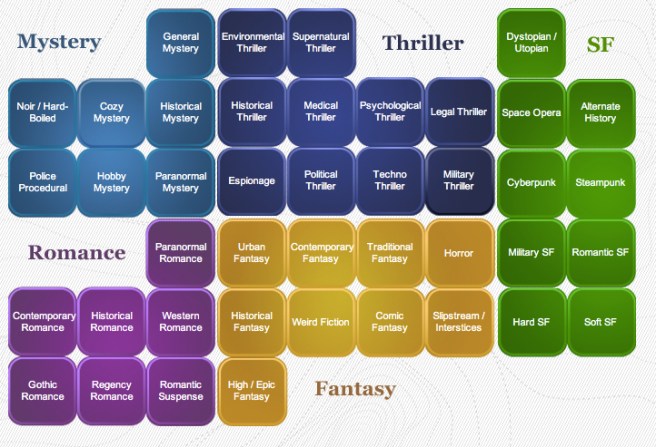
Hello, hello!  When submitting to agents, one of the most common questions a writer has to answer is what genre they write.  Sometimes, this is a really difficult thing to explain, especially if you’re not quite sure yourself.  Granted, I know some writers who can tell you what they write down to the subgenre’s subgenre.  But, I’m not one of them.  And honestly, they kind of freak me out (but I still love them).  I never really understood how people could stick to such narrow categories in order to be a specific type of writer.  It always seemed constrictive to me.  But I eventually fell into a genre and it felt good to know where I belonged, even if I do have a tendency to wander away from it.  So, I thought I’d share how I found my genre.

genre-map
A genre map… and this is just the basics, not including YA and the like.

When I first got into Stonecoast, I had people asking me what I wrote and my go-to response was horror.  At the time, it’s what most of my writing vaguely (and not so vaguely) fell under.  But the truth was, I was still searching for what I was most comfortable writing.  I liked dabbling in all kinds of genres, and still do.  It was always fun for me when I stepped outside of my comfort zone, so I never really felt right restricting myself with genre labels.  Don’t get me wrong, horror was and will always be my true love, but it’s not an entirely accurate description of my writing.

It wasn’t until my fourth semester, during my first half workshop with Nancy Holder (who had also been my mentor my first semester), that I started narrowing in on what genre I felt most comfortable in.  When I was on the chopping block, Nancy said my story was “vintage Shawna.”  She went on to explain that in her time working with me, she noticed that I tended to write about younger (usually teenaged) protagonists who stumbled upon hidden worlds.  She wasn’t wrong.  Apparently, I had fallen into the YA (young adult) realm when I wasn’t looking.

sub-buzz-29538-1490304640-6
I admit this is totally what I thought of when I was accused of writing YA.

It wasn’t exactly my genre of choice, but YA chose me, so I couldn’t argue with it.  Granted, I’ve managed to keep my horror leanings even in most of my YA work.  Demons and psychological torture and all of that still play big roles in my writing, but there’s also a stronger thread of good old-fashioned fantasy as well.  Now, I mostly tell people that I write supernatural YA (not to be confused with paranormal romance) or just YA fantasy.  It’s closer to the truth for the majority of my work.  Though, I do have pieces that don’t fall anywhere near those genres, because writing is hard enough without restricting yourself to one genre.

Writingishard
It really is sometimes.

So, I found my genre when I wasn’t even looking.  Actually, I guess it found me.  But I will always suggest stepping outside your genre, whether when reading or writing or both.  It’s fun and challenging and you can learn a lot when you’re working outside your comfort zone.

What about you?  Have you found your genre yet?  If so, how?  Do you like working within super specific boxes or do enjoy the freedom of vagueness and blurred lines?  Share your thoughts and comments here or on my social media pages!

Father’s Day Is Coming

Hello, hello!  Since Sunday (the 18th) is Father’s Day over here, I thought I’d tell y’all about my dad, Gary.  If you’re friends with me on Facebook, you’ve probably heard a lot of this before, so sorry in advance for the repetition.  Anyway, I’m not really good at the whole sappy emotional thing, so I know I don’t tell him how much I appreciate him enough.  So, I thought I’d give it a shot in writing (because I’m better at putting words on pages than I am at speaking).

12310696_10153290948051716_4911173510513371495_n
Dad and I at the MDA Christmas party in 2015.

Since Mom died in 2011, Dad has dropped everything to become my sole caregiver.  He learned to take care of me basically from scratch and my less than perfect instructions.  Yeah, he had an idea of what to do from watching Mom, but since she did everything before, he didn’t know all the ins and outs.  It’s one thing to see what has to be done with me, but another thing entirely to actually do it, to learn my limitations and how to work around them.  But he did it, and we’ve got a good routine going.

We compromised on a sleep schedule (I used to stay up until four or five in the morning and sleep all day while he was usually in bed by ten and up around six).  He always asks my opinion before doing any remodeling around the house.  I’m always in the loop about major purchases.  When it comes to things like life and the house and all that, he treats me like an adult and an equal because that’s the kind of person he is.

198
The nightstand and part of the bed he built for me.

On top of all of that, he custom built all of my furniture to hide all of my medical equipment.  Who would guess there’s a ventilator hidden in that nightstand?  It started with a desk that comes out in a point, like the corner of a table, so I can get to it more easily than a regular desk.  You can see it here.  That’s nestled between two armoires.  The one on the left has a special drawer that used to house my Xbox at a reachable height back when I could still game.  Then came the bed, because I didn’t like the looks of my hospital bed.  And finally, the nightstand to hide the vent and for storage.

054
That time he made a stack of panaffles (waffle inside a pancake) with Nutella and raspberry puree.

He’s also the best cook I know.  He makes a pastrami from scratch, smokes all kinds of things (including mac and cheese once or twice), and that’s just his bbq skills.  I’ve been spoiled by his Italian, since I’d rather he cook it than go out for it.  He also likes to experiment with new things.  Yeah, I’m definitely spoiled.

Okay, maybe I’m just bragging now, but these are just a few things I appreciate about him.  So, happy (almost) Father’s Day to my dad and all the other dads who might be reading this!  Feel free to share something about your own father figure here or on my social media pages.  I’d love to hear some of your stories.

Chase Them Up A Tree…

Howdy, howdy!  I was recently talking to a friend about putting our characters through hell (whether literally or figuratively).  He was a little worried that people would be upset and accuse him of torturing his young female characters simply as a catalyst to turn them into “strong, empowered women,” as if that’s a bad thing (the torture as a catalyst thing, not the strong women thing).  We talked about the story and that certainly doesn’t sound like the case, but so what if it is?  What’s wrong with strong female characters having a tragic background?  A lot of male characters have it pretty rough before becoming heroes, so why should female characters be any different?  It got me thinking about some of the most common writing advice I’ve heard: chase your characters up a tree, then throw rocks at them/make them walk through the fire/etc.

33badfcbdde1c0fe6557f50fa9a69d9b

What does that even mean, chasing them up a tree?  Well, it means that you should put your character in a bad situation, then pile on some more trouble.  Nobody wants to read about a person who goes to the beach, where it starts raining, and they immediately find shelter in a dingy little restaurant where they have a nice meal, then they go home.  For genre readers, make the restaurant haunted or infested with pixies or run by some super attractive person who seduces the protagonist.  If you’re more into literary fiction, throw in some existential angst or a discovery of some lost love or an awkward conversation with a guy who knows the protagonist but the protagonist can’t remember him or whatever.  In other words, it means you need to keep things interesting.

Another piece of advice to new writers, usually used as an explanation for running characters up a tree, is to make them walk through the fire.  This kind of thing is especially easy to understand if you’re into genre fiction, because the Hero’s Journey often requires entering an unknown world (sometimes actually made of fire) and having the hero traverse the treacherous land.  Whether they come out unscathed or not is really up to you.  Either way, they’re forced to face numerous obstacles or trials along their journey and it transforms them into the people they become.

EmilysQuotes_Com-amazing-great-inspirational-motivational-matter-walk-fire-Charles-Bukowski

In my humble opinion, I don’t think we should really worry about whether or not people will approve of our stories.  If your character needs to be tortured physically or mentally to move the plot along and help them develop into who they need to become, whether male or female, go for it.  That’s not to say that something so drastic is always needed.  Maybe your character grows up in a loving home and stumbles upon an adventure randomly.  After all, one of my own characters is surrounded by supportive and caring family throughout her adventures.  That’s great too.  Trust your story to tell you what it needs, not judgmental people who think violence has no place in literature.

28673-Trust-Your-Story

Disclaimer: I am by no means endorsing gratuitous violence or anything that’s done “just because.”  It has to move things forward and serve some sort of purpose.  That being said, don’t worry so much about what people might think and just write your stories.  If things feel a little excessive, that’s what revision is for!  You can always change things up later on.

What about you?  Do you find yourself worrying about things like this or are you all about running characters up trees and pelting them with rocks?  Share your thoughts here or on my social media pages!

A Short Reading List

Hello, hello!  As I mentioned in my last post, I’ve been slacking on my reading lately, but I’ve started up again.  I thought I would use this week’s post as a chance to share the next five books on my ever-expanding reading list.  I’ve decided to keep them in the “fun” category, at least until I get back into a good rhythm, then I’ll probably add in some craft books and maybe some classics.  After all, part of a writer’s job is to read.  So, here are the books, in no particular order.

81qfrKAYBaL

1. Kushiel’s Dart by Jacqueline Carey.  This is actually the book I’m currently reading, because a friend recommended it.  I’m only 75ish pages in, but my initial thoughts are that I really like the story, there are just a lot of words (it’s kind of flowery, which makes it difficult for me to read more than a couple of chapters at a time).

From the back cover:

The land of Terre d’Ange is a place of unsurpassing beauty and grace. It is said that angels found the land and saw it was good…and the ensuing race that rose from the seed of angels and men live by one simple rule: Love as thou wilt.

Phèdre nó Delaunay is a young woman who was born with a scarlet mote in her left eye. Sold into indentured servitude as a child, her bond is purchased by Anafiel Delaunay, a nobleman with very a special mission…and the first one to recognize who and what she is: one pricked by Kushiel’s Dart, chosen to forever experience pain and pleasure as one.

Phèdre is trained equally in the courtly arts and the talents of the bedchamber, but, above all, the ability to observe, remember, and analyze. Almost as talented a spy as she is courtesan, Phèdre stumbles upon a plot that threatens the very foundations of her homeland. Treachery sets her on her path; love and honor goad her further. And in the doing, it will take her to the edge of despair…and beyond. Hateful friend, loving enemy, beloved assassin; they can all wear the same glittering mask in this world, and Phèdre will get but one chance to save all that she holds dear.

Set in a world of cunning poets, deadly courtiers, heroic traitors, and a truly Machiavellian villainess, this is a novel of grandeur, luxuriance, sacrifice, betrayal, and deeply laid conspiracies. Not since Dune has there been an epic on the scale of Kushiel’s Dart-a massive tale about the violent death of an old age, and the birth of a new.

51l3TFMwN6L2. The Scorpio Races by Maggie Stiefvater.  I ran across the opening of this one while searching for quotes for my website and decided to check it out.  I’m looking forward to reading it.

From the back cover:

Some race to win. Others race to survive.

It happens at the start of every November: the Scorpio Races. Riders attempt to keep hold of their water horses long enough to make it to the finish line.
Some riders live.
Others die.
At age nineteen, Sean Kendrick is the returning champion. He is a young man of few words, and if he has any fears, he keeps them buried deep, where no one else can see them.
Puck Connolly is different. She never meant to ride in the Scorpio Races. But fate hasn’t given her much of a choice. So she enters the competition – the first girl ever to do so. She is in no way prepared for what is going to happen.
51gKAVDyENL

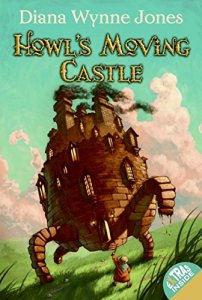
3. Howl’s Moving Castle by Diana Wynne Jones.  I’ve seen the anime a few times, and there was always something missing from it for me, so I’ve decided to read the book to see if I can figure out what that missing bit is.

From the back cover:

Sophie has the great misfortune of being the eldest of three daughters, destined to fail miserably should she ever leave home to seek her fate. But when she unwittingly attracts the ire of the Witch of the Waste, Sophie finds herself under a horrid spell that transforms her into an old lady. Her only chance at breaking it lies in the ever-moving castle in the hills: the Wizard Howl’s castle. To untangle the enchantment, Sophie must handle the heartless Howl, strike a bargain with a fire demon, and meet the Witch of the Waste head-on. Along the way, she discovers that there’s far more to Howl—and herself—than first meets the eye.

51kTIlXatRL4. Daughter of Smoke & Bone by Laini Taylor.  I came across this one a while back while browsing books on Amazon.  It sounded interesting, so I bought an ebook copy, then forgot I had it.  It’s about time for me to get to it.

From the back cover:

Around the world, black handprints are appearing on doorways, scorched there by winged strangers who have crept through a slit in the sky.

In a dark and dusty shop, a devil’s supply of human teeth grown dangerously low.

And in the tangled lanes of Prague, a young art student is about to be caught up in a brutal otherwordly war.

Meet Karou. She fills her sketchbooks with monsters that may or may not be real; she’s prone to disappearing on mysterious “errands”; she speaks many languages–not all of them human; and her bright blue hair actually grows out of her head that color. Who is she? That is the question that haunts her, and she’s about to find out.

When one of the strangers–beautiful, haunted Akiva–fixes his fire-colored eyes on her in an alley in Marrakesh, the result is blood and starlight, secrets unveiled, and a star-crossed love whose roots drink deep of a violent past. But will Karou live to regret learning the truth about herself?

611CsCj3YML5. Guardian of the Dead by Karen Healey.  This book was recommended reading for a lecture I attended at Stonecoast, but I never got around to reading it.  It sounds interesting, so I think I’ll give it a shot.

From the back cover:

“You’re Ellie Spencer.”

I opened my mouth, just as he added, “And your eyes are opening.”

Seventeen-year-old Ellie Spencer is just like any other teenager at her boarding school. She hangs out with her best friend Kevin, she obsesses over Mark, a cute and mysterious bad boy, and her biggest worry is her paper deadline.

But then everything changes. The news headlines are all abuzz about a local string of serial killings that all share the same morbid trademark: the victims were discovered with their eyes missing. Then a beautiful yet eerie woman enters Ellie’s circle of friends and develops an unhealthy fascination with Kevin, and a crazed old man grabs Ellie in a public square and shoves a tattered Bible into her hands, exclaiming, “You need it. It will save your soul.” Soon, Ellie finds herself plunged into a haunting world of vengeful fairies, Maori mythology, romance, betrayal, and an epic battle for immortality.

Well, that’s (a tiny excerpt from) my current reading list.  Feel free to share your list or recommend some books for me on here or on my social media pages!
Thoughts on Gaiman’s Norse Mythology

Howdy, howdy!  I recently finished reading Norse Mythology by Neil Gaiman and thought I would share some of my feelings about it.  Let me start by explaining that it’s the first book I’ve really sat down and read in a long time.  I’ve started others, but nothing has held my attention beyond the first few pages lately (not that they were bad, I just haven’t been in a mood that’s good for reading).  So, I thought maybe a book of short stories by one of my favorite authors would get me back into a reading rhythm.  It worked and here we are.

7828138-0-norsemythology-3D
You have to admit it’s a pretty book.

If I’m being honest, I can’t think of a single Neil Gaiman book I’ve read that I don’t have mixed feelings about.  Norse Mythology is no exception.  Yet his stories hold a special place in my heart despite everything I question (or even hate) about them.  Why?  Usually because there’s something memorable about the worlds or because I can relate to the characters.  Not to mention that I simply enjoy his writing style, which is clear and simple and easy to get lost in.

But Norse Mythology is different, because this isn’t one of Gaiman’s worlds and these aren’t his characters.  These stories have been around for centuries.  This collection is just those stories written with his voice.   These are the tales of the gods of Asgard.  We start with a brief introduction to the main players, then get into the creation myth and work our way through a number of notable moments until we get all the way to Ragnarok.  These are tales many of us have heard before in one form or another.  It makes it really difficult for me to figure out if I liked the stories because I’m familiar with a lot of them already or because of the way Gaiman tells them.  I like to think it’s a little bit of both.

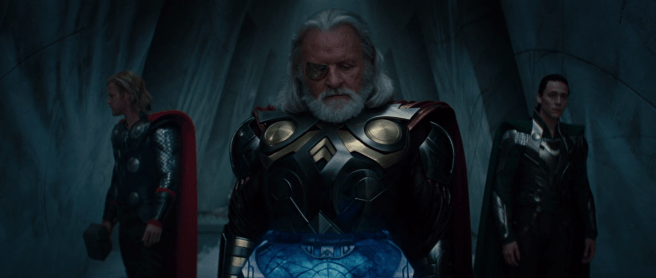
Thor_Odin_Loki
If you read it, don’t go into these stories expecting the Marvel version.

As I mentioned, though, I had some mixed feelings about Norse Mythology.  While I loved the stories, I kept running across moments that I wanted to see better, rather than just being told about.  Don’t get me wrong, I know that this collection was written more in the vein of oral storytelling, which is vastly different from the written story in that it needs to be quick and easy to understand and entertaining, whereas you could spend ten pages of a written story describing a flower (you shouldn’t, but you could).  I get that, but one of the golden rules of writing is to show, not tell.  It’s really hard for me to ignore that rule.  There were just a few parts that I thought would’ve benefited from a little more action.

the_children_of_loki_by_jap_jap-d4cemo4
Because Loki’s kids were awesome and got the short end of the stick.

Ultimately, I enjoyed Norse Mythology.  It’s definitely a book I would recommend to people, especially if they’re new to the mythology and want to get a quick, but fairly in depth introduction to it.  What about you?  If you’ve read the collection, feel free to share your thoughts here or on my social media pages!
When In Doubt…

Hello, hello!  I thought I’d share a little update on the agent search saga.  I received a rejection from the agent who requested a full copy of my manuscript.  It was the first rejection that I couldn’t attribute to slush reader denial, and I admit it threw me a bit, emotionally.  They loved Bailey (the main character), but they suggested reworking it into a non-fantasy book because they felt my writing was strongest in the non-fantastical parts.  I panicked.  How was I supposed to rewrite this particular story without fantasy and keep it from turning into a memoir or something similar (there’s too much of my younger self in Bailey to keep her in the realm of literary fiction even if I managed to peel the fantastical parts away)?  I’ve always been against crossing into CNF, especially when it involves elements of my own life (I’m not that interesting, I swear).  I have nothing against people who want to write that type of stuff, but it’s just not who I am.  So, I let myself be overcome by doubt for a couple of days.

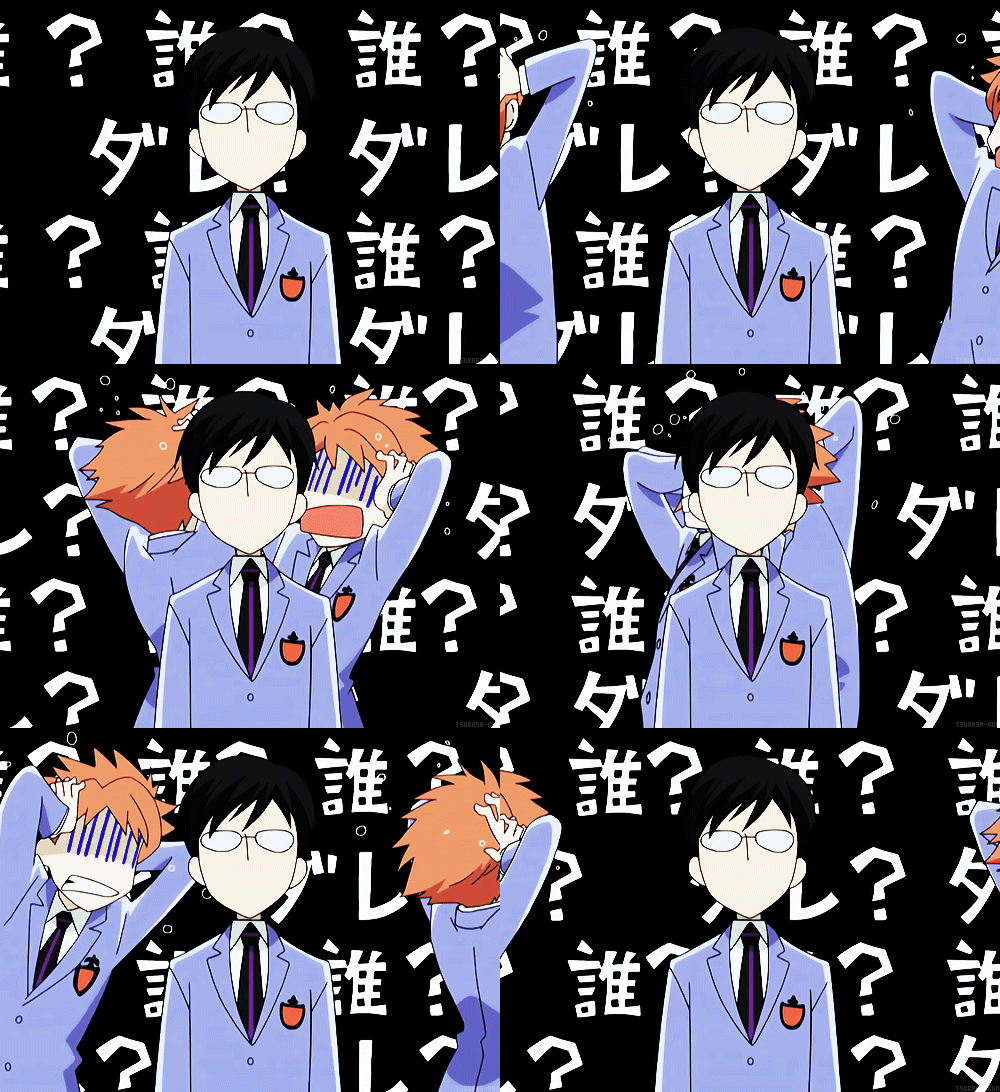
zZL4Oqk1PljdC
Me normally?  Kyoya.  Me on rejection day?  The twins.  I will never be Tamaki, though.

It’s been a long time since I’ve received a critique (no matter how small) from someone who held my inner writer’s fragile little ego in their hands and had the ability to crush it.  I love my critique group dearly, but I know they’ll give honest feedback in a friendly manner.  When I was in school, I actually liked the people who were brutal with their feedback.  I welcomed it.  But over the past couple of years, I kind of forgot that a critique is just someone else’s opinions, whether that someone is a friend or a teacher or an agent or whoever.  It’s simply one person’s opinion.  Yeah, it’s harder to hear some people’s thoughts than others, but the story is still mine.  I can’t help but feel like I’ve gotten a little weak for forgetting that.

For a couple of days after I received the rejection, I stopped working on my current WIP (the second book in the series).  What was the point if I was just going to have to change the first book completely?  Then, I remembered something my mentor for my thesis semester (Elizabeth Hand) wrote in my evaluation.  She basically said that I was always extremely open to suggestions for edits and revisions, but that I had zero qualms about saying no to things because I knew what was best for my story.  That was when I started working on my WIP again.  This series started as litfic and went nowhere.  It wasn’t until someone suggested I write it as the kind of stuff I actually enjoyed reading that it started moving forward on its own.  I just can’t abandon that story yet.

How+About+No
My usual reaction when I come across suggestions that don’t fit my stories.

Sometimes, we all need a little reminder that we’re the creator of the worlds we write about.  We choose which suggestions and comments to implement and which ones to ignore.  That’s our decision to make as writers.  I know it’s hard to ignore some people’s critiques, especially when they’ve been in the business a lot longer than you and when they’re successful and you’re just getting started.  Be open to suggestions, but don’t be afraid to say no if it doesn’t feel right.  You know what’s best for your stories.

keep-calm-and-trust-yourself-96.png
No matter how hard it is.

So yeah, when in doubt, trust yourself.  I’m going to try to remember this as future rejections roll in.  I can’t promise I won’t temporarily panic, but I’ll get over it given time.  If you’re in a similar situation, you’ll be okay too.  Let yourself freak out a little if that’s your thing (I, personally, prefer to avoid that step), but then remember that you know what you’re doing.  We will succeed… eventually.